Most QR codes are free to generate. And most QR campaigns are completely invisible to the marketers running them.
you can download a static QR code in thirty seconds at zero dollars. But the moment you print it on packaging, menus, or signage, you have locked in a destination you cannot change, a scan you cannot track, and a campaign you cannot attribute to any outcome.
This guide breaks down exactly what QR codes cost in 2026, from free tools to paid platforms, and what you actually get at each price point. More importantly, it explains why the cheapest option often carries the highest campaign cost.
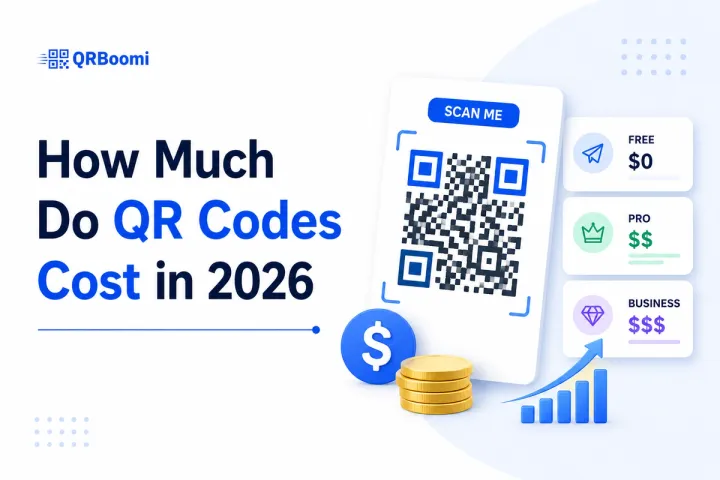
QR code costs in 2026 range from free (static codes with no tracking) to $300 or more per year for full-featured dynamic campaign platforms. Specifically, free tools generate one-time, uneditable codes with no analytics. Paid plans, typically starting at $5 to $15 per month, add dynamic editing, scan tracking, branded design, and conversion attribution. For businesses running real marketing campaigns, the paid tier is not optional: it is the only tier where QR performs as a trackable campaign asset rather than a printed URL.
The Real QR Code Cost Question
Here is what most brands get wrong about QR code pricing: they ask how much the code costs and skip the more important question entirely.
The more important question is: what does the code cost you if it does not perform?
A static QR code printed on 50,000 product labels at zero software cost is technically free. But if that code links to a broken page, a product that is out of season, or a promotion that has ended, the reprinting bill will remind you that free is relative.
Across campaigns on QRBoomi, we see the same pattern repeatedly. Brands choose the free or lowest-cost option, print at scale, and then have no way to update destinations, measure scans, or connect the offline touchpoint to any digital outcome. The QR code exists. The campaign does not.
That is the problem this guide is designed to solve. Here is every price tier, every cost factor, and the honest answer to when you need to pay and when you do not.
Static vs Dynamic QR Codes: What You Pay and What You Get
Before pricing, you need to understand the structural difference between the static vs dynamic qr codes types. This is not a technicality. It determines everything about how your campaign performs.
Static QR Codes: Free, But Fixed
A static QR code encodes information permanently at the point of creation. You choose a URL, the generator creates the code, and that relationship is permanent. You cannot edit the destination after printing.
Static codes are free from almost every major tool. QR Code Generator, QRStuff, GoQR, and dozens of similar platforms generate static codes at no cost. You download, you print, you hope the destination never needs to change.
Where static codes break down for campaign use:
- No editing after print. If your landing page URL changes or your promotion ends, the code keeps sending people to the wrong place.
- Zero scan analytics. You have no data on how many people scanned, when, where, on what device, or what they did next.
- No A/B testing. You cannot test which destination drives more conversions from the same physical asset.
- No campaign lifecycle. The code exists in isolation. It cannot be part of a tracked, managed campaign.
Dynamic QR Codes: Paid, But Performant
A dynamic QR code points to a redirect URL that you control after printing. Change the destination, run a test, update a promotion, and the physical code continues to work. The code itself never changes. The campaign behind it does.
Dynamic codes are the foundation of every high-performing QR campaign we see at QRBoomi. The scan data they generate is not a nice-to-have. It is how you prove the channel works and justify the print spend.
Dynamic QR codes cost money because the platform has to maintain the redirect infrastructure, serve analytics data, and keep the campaign live. That cost is real and it is worth understanding.
QR Code Pricing Tiers in 2026
Here is an honest breakdown of what you pay and what you get at each tier:
| Tier | Monthly Cost | Code Type | Analytics | Best For |
|---|---|---|---|---|
| Free Tools | $0 | Static only | None | One-off personal use, low-stakes testing |
| Entry Paid | $5 - $15/month | Dynamic (limited) | Basic scan counts | Small businesses, single campaigns |
| Professional | $15 - $50/month | Dynamic (full) | Full scan-to-outcome | Marketing teams, multi-campaign management |
| Agency / Enterprise | $50 - $300+/month | Dynamic + Bulk | Advanced attribution, API access | Agencies, multi-location, multi-brand operations |
A few things worth noting here.
Most free tools include no campaign management, no branded design, and no way to connect scan data to conversion outcomes. They generate a code. That is where the service ends.
Entry-level paid plans typically limit the number of active dynamic codes and cap scan data at aggregate totals without location, device, or time breakdowns. They are fine for single campaigns with modest scale.
Professional plans, typically in the $15 to $50 range, are where QR codes start functioning as proper campaign assets. You get full scan-to-outcome tracking, branded code design, destination editing, and the data exports that actually make it into a marketing report.
Enterprise and agency tiers add bulk creation, multi-user access, white-labeling, API integrations with CRMs and analytics platforms, and dedicated support. If you are running QR campaigns across ten or more locations, or managing codes for multiple clients, this is the tier you need.
What Drives QR Code Pricing? The Key Cost Factors
Understanding what goes into a QR platform's pricing helps you evaluate plans honestly rather than defaulting to the cheapest option.
1. Dynamic vs Static Capability
The single biggest pricing lever. Every platform that charges for QR codes is essentially charging for dynamic functionality, the infrastructure that keeps your redirect live and editable. Static code generation costs nothing at scale. Dynamic campaign management does.
2. Scan Volume and Active Code Limits
Many platforms structure pricing around scan caps (the maximum number of scans per month before throttling or overage charges) and active code limits (the number of live dynamic codes your plan supports simultaneously). Watch these carefully. A campaign with heavy physical distribution can burn through a scan cap faster than you expect.
3. Analytics Depth
Aggregate scan counts are free or near-free. Full analytics, meaning scan time, location data, device type, browser, referral source, and conversion tracking, cost progressively more. If your marketing team needs to report on QR campaign ROI, you need the tier that includes this data.
4. Branded QR Design
Custom colors, logo embedding, and branded QR frames are not cosmetic. Branded codes see meaningfully higher scan rates than generic black-and-white squares. Platforms that include design customization in professional tiers are not charging you for aesthetics. They are charging you for the engagement lift that comes with it.
5. Landing Page Builder
Some platforms include QR mobile-optimized landing page builders within the platform itself, eliminating the need to create and host a separate destination page. If your campaign needs a mobile-first destination, this can replace what would otherwise be a separate tool cost.
6. Team Access and Multi-Location Management
Single-user plans are priced accordingly. When you add team seats, location-specific campaign management, and multi-brand organization, pricing scales. For agencies and enterprise brands, this is the correct trade: centralized management at scale beats fragmented one-off campaigns every time.
7. API and Integration Access
Connecting your QR campaign data to your CRM, marketing automation platform, or analytics stack requires API access. This is an enterprise-tier capability on most platforms and for good reason: it is the feature that turns QR from a standalone channel into part of your measurable marketing infrastructure.
When Free QR Codes Are Enough (And When They Are Not)
Free static QR codes are appropriate in two situations.
First: personal or one-time use. A QR code for your personal portfolio site, a wedding RSVP, or a one-day event where reprinting is not a concern and scan data is not needed. Static works.
Second: fully stable, low-stakes destinations. If you are linking to a permanent resource that will never change and you genuinely have no need to measure engagement, a free static code is sufficient.
Everything else, any business context where the destination might need to change, where scan performance matters, where the code appears in print at any meaningful scale, calls for a dynamic campaign platform. The cost difference between a free static code and a professional dynamic platform is roughly the price of one pizza a week. The performance difference is not close.
We have seen campaigns where brands printed a free static QR code on a retail insert and the landing page URL was updated a month later. Every scan after that update sent customers to a 404 page. There was no way to fix it without reprinting. The reprint cost was seventeen times the annual cost of the dynamic platform they could have used from day one.
How to Calculate the True Cost of a QR Campaign
The QRBoomi Campaign Cost Framework treats QR expenses as three distinct buckets. Most brands only look at bucket one.
Bucket 1: Platform Cost
The monthly or annual subscription to your QR platform. This is the number everyone focuses on. It is also the least impactful cost in most campaigns.
Bucket 2: Print and Production Cost
The cost of the physical asset carrying the QR code. Packaging, menus, signage, inserts, outdoor placements. This is typically the largest spend in a QR campaign and the one that is hardest to reverse. Static codes make this cost permanent and unchangeable. Dynamic codes keep it flexible.
Bucket 3: The Opportunity Cost of Missing Data
This is the number no invoice captures. Every scan that goes untracked is a potential customer whose behavior you cannot learn from. Every campaign you cannot attribute is budget you cannot defend. Every destination you cannot update is a conversion you lose to a dead page.
When you calculate cost per attributed scan and compare a tracked dynamic campaign against an untracked static one, the dynamic platform pays for itself within the first few hundred scans on any campaign with meaningful print distribution.
QRBoomi POV: The Cost That Does Not Show Up on Any Invoice
At QRBoomi, we believe the question "how much does a QR code cost?" is the wrong place to start. The right question is: what does your campaign cost when your QR code cannot be measured, edited, or attributed? That is the cost most brands are already paying without realizing it. Every scan is a data point. If your platform cannot capture it, you are running a campaign you cannot see. The platform cost is not the expense worth worrying about. The invisible campaign is.
Key Takeaways
- QR codes cost anywhere from $0 (static, no tracking) to $300+ per year (dynamic, full campaign analytics and attribution).
- Free QR codes are static. They cannot be edited after printing and generate zero campaign data.
- Dynamic QR codes, the foundation of any real campaign, start at roughly $5 to $15 per month for entry-level plans.
- The biggest cost factors in QR pricing are dynamic capability, analytics depth, branded design, team access, and API integrations.
- The true cost of a free static code in a campaign context is not $0. It is the sum of untracked scans, uneditables destinations, and lost attribution.
- For any campaign with meaningful print distribution, a professional dynamic platform pays for itself within the first few hundred attributed scans.
- If your QR code is not driving measurable outcomes, the problem is not the code. It is the campaign behind it.
Frequently Asked Questions
Static QR codes are free from most generators. Dynamic QR codes, which allow editing after print and include scan analytics, typically cost between $5 and $50 per month depending on the platform and feature set. For any marketing campaign context, the dynamic tier is the relevant one.
Free QR codes are almost always static: fixed destination, no analytics, no editing after creation. Paid QR codes are dynamic: editable destinations, full scan tracking including device, location and time data, branded design options, and conversion attribution. The difference is the difference between printing a URL and running a campaign.
Dynamic QR code pricing starts at around $5 per month for basic plans and scales to $50 or more for professional plans with full analytics, bulk code management, branded design, and API integrations. Enterprise and agency plans with multi-user access and white-labeling typically run $100 to $300 per month.
If your QR codes appear on any physical material at scale and you need to measure performance or update destinations without reprinting, yes. The platform cost is small relative to print costs and the campaign revenue you would otherwise leave unattributed. Free static codes are appropriate only for personal or one-time, low-stakes use.
Truly free static QR codes do not expire since the destination is baked into the code itself. However, some free trials of QR platforms will deactivate dynamic codes when the trial ends, breaking the redirect. Always confirm whether your code type is static or dynamic before printing at scale.
Not reliably. Most free tools provide no scan tracking at all. A small number of free tiers offer basic aggregate scan counts without location, device, or time data. Full scan-to-outcome attribution requires a paid dynamic platform. For any campaign where performance measurement matters, the paid tier is the only option that gives you actionable data.
Yes. QRBoomi offers a free trial that lets you create dynamic QR campaigns, test scan tracking, and explore the branded design tools before committing to a paid plan. Visit qrboomi.com to get started.