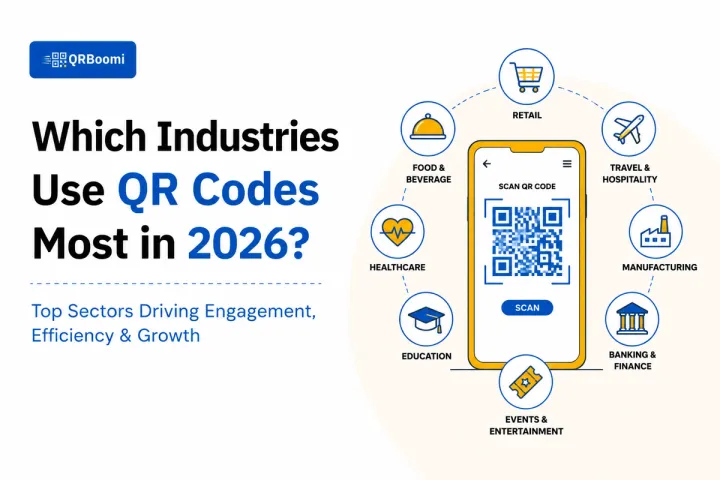
Which Industries Use QR Codes Most in 2026?
Most QR code trend articles give you a list of industries and move on. This is not that article.
The question that matters for any marketer or operator in 2026 is not whether QR codes are being used. They are. QR scan volume has grown year-on-year since 2020, and mobile-first consumer behaviour has made the QR scan a default action across virtually every touchpoint.
The question is: which industries have figured out how to turn a scan into an outcome? And what separates the sectors running QR campaigns from those generating one-off codes with nothing to track?
Below, we break down the top QR-adopting industries in 2026, what is driving their results, and what every marketer can take from their campaign approach.
Summary
Which industries use QR codes most in 2026? Retail, food and beverage, healthcare, hospitality, and consumer packaged goods lead QR code adoption globally. Each industry uses QR codes differently: retail for scan-to-purchase journeys, restaurants for digital menus and loyalty, healthcare for patient information, and CPG brands for packaging campaigns that connect physical products to digital funnels with full scan-to-outcome tracking.
Why Industry Matters More Than Adoption Rate
Across QRBoomi campaigns, the industries with the highest scan-to-outcome conversion rates share three things: they use dynamic codes that can be updated without reprinting, they have a clear destination strategy before the code goes live, and they track beyond scan volume to actual campaign outcomes.
Industries that treat QR codes as static redirects consistently underperform. The gap between a QR code and a QR campaign is where ROI lives. Here is who has figured that out.
Retail: QR as the Physical-to-Digital Bridge
Retail is the highest-volume QR environment in 2026. Point-of-sale displays, shelf talkers, window signage, fitting room prompts, and receipts all carry QR codes. The physical retail environment has become a distributed campaign surface.
The brands winning in retail QR are not using codes to redirect to a homepage. They are building scan-to-purchase flows: a code on a shelf talker goes to a product video, a customer review collection page, or a limited-time offer that expires in 24 hours.
The dynamic advantage here is significant. Retail promotions change weekly. A dynamic QR code on permanent shelf signage can be updated to match the current promotion without reprinting a single piece of POS material. Across QRBoomi retail campaigns, brands using dynamic codes for in-store promotions see materially higher engagement because their destinations are always current and relevant.
What retail does best: pairing QR with a specific conversion goal at the moment of decision. The scan happens when the customer is already considering the product. The campaign destination must meet that intent.
Food & Beverage: From Menus to Loyalty Campaigns
Restaurants, cafes, and QSR chains represent the single largest driver of normalised QR behaviour among general consumers. The contactless menu adoption that accelerated post-2020 made QR scanning a habit for an entire generation of diners.
But the smartest food and beverage operators have moved well beyond the static menu PDF. QR campaigns in this vertical now power: digital menus that update in real time, loyalty programme sign-ups triggered at the table, seasonal promotions tied to specific dishes, and post-visit review capture flows.
The loyalty QR play is particularly powerful. A code on a table card or receipt can capture a customer's mobile number or email for a loyalty programme, triggering an automated follow-up sequence. The scan is the opt-in.
The operators using dynamic QR codes can run a breakfast campaign in the morning and a dinner offer by 5pm on the same code. The code stays on the table. The campaign changes. That is the update without reprinting advantage at its most practical.
Healthcare: Information Delivery at the Point of Need
Healthcare is one of the fastest-growing QR adopters in 2026, driven by a clear use case: delivering the right information to the right patient at the right moment, without requiring a staff member to hand over a leaflet.
QR codes appear on prescription packaging, hospital discharge paperwork, clinic waiting room signage, medical device packaging, and patient appointment reminders. The scan takes the patient to medication instructions, post-operative care guides, appointment booking flows, or telehealth check-in portals.
The compliance advantage of dynamic QR codes is significant in this sector. When guidelines change, a dynamic code can be updated immediately. The physical material, already printed and distributed, continues to deliver accurate, current information. For healthcare providers managing compliance across hundreds of locations, this is not a convenience feature. It is a risk management tool.
QR codes in healthcare also support first-party data collection at consent, connecting physical patient interactions to digital health journeys without friction.
Hospitality & Travel: High-Touch QR Experiences at Scale
Hotels, airlines, cruise lines, and hospitality groups have adopted QR as the primary interface between guests and services. Room service menus, concierge directories, spa booking flows, loyalty programme check-ins, and in-room entertainment guides are all QR-delivered in 2026.
The campaign opportunity in hospitality is upsell. A QR code in a hotel room that surfaces the spa menu, an upgrade offer, or a dining reservation link is a revenue-generating campaign asset, not a directory shortcut. The brands treating room QR codes as campaign touchpoints are generating measurable incremental revenue.
Multi-location hospitality brands benefit most from centralised dynamic QR management. A hotel group running 50 properties can update a seasonal promotion across every room card in every property in minutes. The alternative is a reprint operation. Across QRBoomi campaigns in hospitality, centralised dynamic management consistently reduces campaign execution time while improving offer relevance.
Consumer Packaged Goods (CPG): Packaging as a Campaign Asset
The CPG sector has the highest-stakes QR environment: codes printed on packaging at scale, often millions of units, that need to remain accurate, engaging, and trackable for the entire product lifecycle.
Leading CPG brands use packaging QR campaigns to: deliver provenance and ingredient storytelling, run scan-to-win promotions, collect first-party consumer data at the point of product interaction, drive follow-on purchase journeys, and connect physical SKUs to digital brand content.
The dynamic code argument is most critical in CPG. A static code on a product package cannot be updated once the product is manufactured. A dynamic code, if the campaign destination needs to change, a promotion ends, a product line is updated, or a recall communication is needed, can be redirected instantly to the correct destination without a product recall or reprint.
For D2C and e-commerce brands bridging physical and digital, the packaging QR code is the cleanest attribution touchpoint available. Every scan is a data point that connects a physical product interaction to a digital journey. The brands tracking this data are building first-party audience profiles that paid media cannot replicate.
Events & Experiential Marketing: Scan-to-Engagement at Live Venues
Events are where QR codes perform at their most immersive, and where most brands still underinvest in campaign design. A QR code on a conference badge, event banner, or branded installation is one of the highest-intent scan moments in marketing.
The attendee scanning a code at an event is engaged, physically present, and actively curious. The campaign destination must match that energy. The top-performing event QR campaigns use codes to: deliver speaker bios and session materials, capture lead data with a single scan, drive social sharing at branded photo moments, enter attendees into competitions, and power post-event follow-up sequences triggered at the moment of scan.
Branded QR design matters most at events. A generic black-and-white code at a premium brand experience is a missed moment. Custom QR codes that carry brand colours, logo, and design language perform better and reinforce brand presence at the point of scan.
Post-event, the scan data becomes a lead list. Every scan is a timestamped, location-confirmed interaction. That data, collected through a QR campaign platform, is the most qualified list an event marketer can generate.
Education: The Quiet High-Volume QR Adopter
Education does not generate the marketing headlines, but it is one of the highest-volume QR environments in 2026. Universities, schools, training providers, and corporate learning platforms use QR codes extensively for: linking printed course materials to digital resources, directing students to assessment portals, sharing campus event information, and enabling library and facility access flows.
The education sector's use case is primarily utility-driven, but the volume and frequency of scans makes it a significant data source for institutions that choose to track engagement. Understanding which learning materials generate the most QR engagement, which campus resources are accessed most, and which student journeys follow specific content paths is campaign intelligence with genuine programme improvement value.
The Industries That Are Still Getting It Wrong
Adoption is not the same as performance. Several industries have high QR code presence but low campaign maturity.
Real Estate
Property listings, window displays, and for-sale boards carry QR codes almost universally in 2026. Most redirect to a static Rightmove or Zillow listing. The campaign opportunity, a branded landing page, a virtual tour, a direct lead capture, is largely untapped. The scan happens. The campaign does not.
Financial Services
Banking and insurance QR codes frequently redirect to generic homepage URLs or PDF downloads that open poorly on mobile. The intent is compliance; the experience is friction. The brands treating QR as a campaign tool in financial services are the exception, not the rule.
Automotive
Dealer showrooms and vehicle brochures use QR codes, but the destinations rarely match the intent of a buyer already standing next to a car. A scan at point of physical contact with the product is a high-intent moment. Redirecting to a manufacturer homepage wastes it.
Key Takeaways
- Retail, food and beverage, healthcare, hospitality, and CPG lead QR code adoption in 2026, each with distinct campaign objectives and scan-to-outcome strategies.
- The highest-performing QR sectors share one characteristic: they use QR codes as campaign assets, not just redirect tools.
- Dynamic QR codes are the operational backbone of high-volume industries like CPG and hospitality, where the ability to update destinations without reprinting is a business requirement.
- Event and experiential marketing generates the highest-intent scan moments. Campaign design at these touchpoints is disproportionately high-value.
- Industries with high scan volume but low campaign maturity (real estate, financial services, automotive) represent the largest near-term performance opportunity.
- First-party data collection through QR campaigns is a competitive advantage for brands in any vertical willing to treat the scan as the start of a data relationship, not the end of a print campaign.
The QRBoomi POV
Every industry on this list has one thing in common: the brands seeing the best QR results are not asking 'Should we use QR codes?' They are asking 'What happens after the scan?' The campaign that answers that question with a clear, dynamic, trackable destination is the campaign that converts. QRBoomi is built for that question. Every code is dynamic, every scan is tracked, and every destination can be updated without touching the print. That is the difference between a QR code and a QR campaign.
Start Your QR Campaign Today
If you are in any of the industries above and your QR codes are still pointing to a static URL, you are leaving scan-to-outcome data on the table. QRBoomi's dynamic QR platform lets you build, update, brand, and track QR campaigns across every physical touchpoint.
Frequently Asked Questions
Retail and food and beverage have the highest QR code scan volume in 2026. Retail codes appear across in-store signage, product packaging, and POS materials. Food and beverage QR codes are embedded in the dining experience at every touchpoint from menus to loyalty programmes, making them the most frequently scanned category per consumer interaction.
Healthcare uses QR codes to deliver patient information at the point of need: prescription packaging, hospital discharge documents, clinic signage, and appointment systems. Dynamic QR codes are particularly valuable in healthcare because they allow institutions to update information (clinical guidelines, appointment flows) without replacing printed materials, supporting compliance across distributed facilities.
Yes, when the destination matches the scan intent. Retail QR codes perform best when they go to specific product pages, limited-time offers, or review capture flows rather than generic homepages. Dynamic QR codes allow retail campaigns to update weekly promotions on permanent POS signage without reprinting. This is the single biggest performance gap between brands with static and dynamic QR strategies.
QR codes on CPG packaging connect physical products to digital brand experiences: ingredient provenance, scan-to-win promotions, loyalty sign-ups, and product tutorials. Dynamic codes on packaging allow brands to update campaign destinations after manufacturing, which is critical when promotions end or product information changes, without triggering a product reprint or recall.
Events use QR codes to capture lead data, deliver speaker content, drive social sharing, and power post-event follow-up. A scan at an event is one of the highest-intent marketing interactions available. Branded QR codes that match the event's visual identity consistently outperform generic codes. Every scan generates timestamped engagement data that becomes a qualified lead record.
Real estate, financial services, and automotive have high QR code presence but low campaign maturity. Codes in these sectors typically redirect to generic URLs rather than purpose-built campaign destinations. The gap between scan volume and conversion outcomes in these industries is significant, representing the largest near-term opportunity for brands willing to treat QR as a campaign asset.
A QR code is a static redirect. A QR campaign is a tracked, dynamic, branded journey that starts at the scan and ends at a measurable outcome: a lead, a purchase, a loyalty sign-up, or a content interaction. QR campaigns use dynamic codes that can be updated without reprinting, branded designs that reinforce identity, and analytics that track every scan through to conversion.