Types of QR Codes: Which One Actually Drives Campaign Results?
Most guides on types of QR codes read like a product catalogue. They list formats — URL, vCard, SMS, WiFi — and leave you to figure out which one belongs in your campaign. That is the wrong question.
The question that actually moves metrics is this: which types of QR codes are built to be updated, tracked, and optimised across the full lifecycle of a campaign? Because the difference between a QR code that generates scans and one that generates revenue is not the data format. It is whether the code can do anything after it ships.
This guide breaks down every major type of QR code, explains how each performs in a real campaign context, and gives you a clear framework for choosing the right type before a single code gets printed.
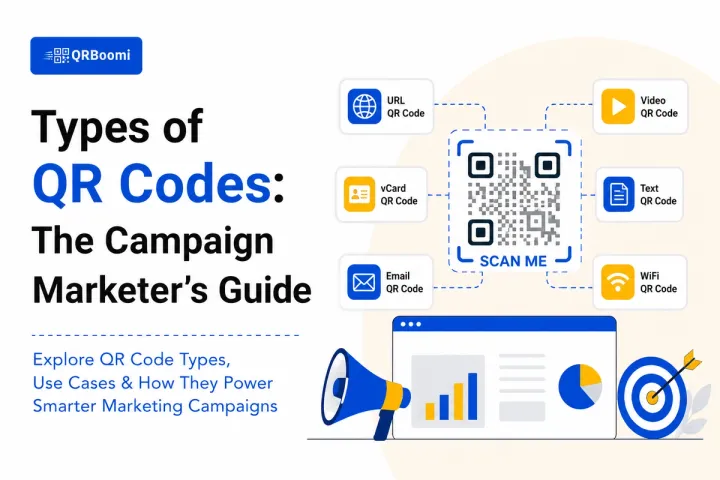
Types of QR Codes: QR codes fall into two structural categories — static and dynamic — and multiple content types including URL, vCard, WiFi, SMS, email, app download, and multi-URL. Specifically, the static-vs-dynamic distinction is the most campaign-critical choice: static codes lock in a fixed destination that cannot be changed after printing, while dynamic codes remain editable, trackable, and rebrandable throughout the entire campaign lifecycle, making them the only viable option for any serious marketing deployment.
The Structural Split: Static vs. Dynamic QR Codes
Before you choose a content type, you need to make a more fundamental decision. Every QR code you create is either static or dynamic. This distinction shapes everything that follows.
Static QR Codes
A static QR code encodes data directly into its pattern. Once printed, the destination is permanent. Change the URL, and you need to reprint. There is no tracking, no analytics, and no ability to run A/B tests.
Static codes have one legitimate use case: one-off, permanent references where the destination will never change and scan data is irrelevant. Think equipment serial numbers or permanent venue directories.
For any marketing campaign, static codes are a dead end.
Dynamic QR Codes
A dynamic QR code stores a short redirect URL in its pattern. The actual destination lives in the cloud. You can update where the code points at any time, from any device, without reprinting anything.
Dynamic codes also unlock full campaign analytics: scan volumes, scan-by-time, device type, geographic location, and when connected to a conversion tracking layer, scan-to-outcome attribution.
Across QRBoomi campaigns, dynamic codes consistently outperform static codes on every measurable engagement metric because they can be optimised in real time rather than locked in before launch.
Campaign Rule: If your QR code is on anything that will be printed, shipped, or displayed for more than one week, it must be a dynamic code. No exceptions.
| Static QR Codes | Dynamic QR Codes |
|---|---|
| Fixed destination | Editable destination anytime |
| No analytics | Full scan-to-outcome analytics |
| No A/B testing | Multi-destination A/B testing |
| Reprint to update | Update without reprinting |
| One-off use only | Full campaign lifecycle management |
| No brand customisation | Logo, colour, and shape branding |
The QRBoomi Type-to-Campaign Framework
Most brands choose a QR code type based on what data they want to encode. That is content-first thinking, and it produces mediocre campaigns.
The QRBoomi Type-to-Campaign Framework flips the order. Start with campaign outcome. Then choose the content type that best delivers that outcome as a dynamic, trackable experience.
| Campaign Outcome | Recommended QR Type | Must Be Dynamic? |
|---|---|---|
| Drive web traffic | URL / Landing Page | Yes |
| Capture lead data | URL to lead form | Yes |
| Share contact info | vCard | Yes (to update details) |
| Grow social following | Social media / Multi-URL | Yes |
| Collect reviews | Google Review URL | Yes |
| Distribute files | PDF / Video / Audio | Yes (update file) |
| Connect to WiFi | WiFi | No (static acceptable) |
| Drive app installs | App Download | Yes |
| Deliver promotions | Coupon / Landing Page | Yes (time-sensitive) |
Types of QR Codes by Content Format
Each content format below should be treated as a campaign asset, not a static reference point. For every type, consider: can this destination change? Can this scan be tracked? If yes to either, use dynamic.
URL QR Codes
A URL QR code encodes a web address and sends the scanner directly to a destination page. This is the most widely used type in marketing campaigns and the foundation for most scan-to-outcome workflows.
The campaign strength of a URL QR code depends entirely on what happens after the scan. A well-constructed URL QR campaign uses a branded short link, tracks UTM parameters, and lands on a mobile-optimised page built specifically for post-scan conversion. A QRBoomi dynamic URL code also lets you change that destination mid-campaign without touching the printed material.
- Best for: Campaign landing pages, product launches, promotional offers, event registrations, retargeting flows
- Dynamic requirement: Always. URL destinations change. Campaigns evolve. Static URL codes are unmanageable at any scale.
vCard QR Codes
A vCard QR code encodes contact information: name, job title, phone number, email, company, and website. When scanned, it prompts the user to save the contact directly to their phone.
For sales teams, event marketers, and professionals using printed business cards, vCard QR codes eliminate friction from the contact exchange. A dynamic vCard code means your contact details can be updated any time without reprinting cards.
- Best for: Business cards, conference badges, event lanyards, networking materials
- Dynamic requirement: Yes. Role changes, phone updates, and company rebrands make static vCard codes unreliable within months of printing.
WiFi QR Codes
A WiFi QR code stores network credentials and connects the scanner to a WiFi network automatically on scan. No password typing required.
Common in hospitality, retail, and coworking spaces. The network name and password are encoded directly into the pattern, which is the one case where a static code is technically acceptable assuming your WiFi credentials never change.
- Best for: Restaurants, hotels, cafes, retail stores, event venues
- Dynamic requirement: Static acceptable if credentials are fixed. Dynamic if you rotate passwords or want to track location-based scan data.
SMS QR Codes
An SMS QR code pre-populates a text message with a recipient number and optional message body. Scanning opens the phone's messaging app ready to send.
Effective for opt-in campaigns, customer service triggers, and lead capture via text. Works well on posters, packaging, and point-of-sale materials where the scan-to-contact journey needs to feel frictionless.
- Best for: SMS opt-in campaigns, customer service triggers, appointment reminders, text-to-win promotions
- Dynamic requirement: Yes for campaign use. Phone numbers and message templates change across campaigns.
Email QR Codes
An email QR code opens a pre-addressed email in the scanner's mail client with a recipient, subject line, and optional body text already populated.
Useful for feedback campaigns, customer service escalation paths, and B2B outreach materials where email is the preferred contact channel.
- Best for: Feedback requests, product registration, press and media contacts, trade show follow-up
- Dynamic requirement: Yes for any campaign with changing subject lines, team inboxes, or routing logic.
App Download QR Codes
App download QR codes detect the scanner's operating system and route iOS users to the App Store and Android users to Google Play automatically. One code, two destinations.
This is one of the highest-value QR types for D2C and retail brands. Print the code on packaging, receipts, or in-store displays to drive app installs without sending users to a generic webpage.
- Best for: Packaging inserts, in-store POS materials, product boxes, print advertising for app-first brands
- Dynamic requirement: Always. App store URLs change with updates. OS detection logic needs cloud management.
Social Media QR Codes
A social media QR code can link to a single profile or, more powerfully, open a multi-platform link page that lets the scanner choose their preferred network.
For brands running awareness campaigns or influencers at live events, social QR codes convert offline attention into follower growth. The multi-URL version is especially effective because it removes the friction of guessing which platform the user prefers.
- Best for: Event activations, product packaging, influencer merchandise, out-of-home advertising
- Dynamic requirement: Yes. Profile handles, new platform additions, and campaign-specific landing pages all require editability.
PDF and File QR Codes
A PDF or file QR code links directly to a hosted document: a menu, product brochure, press kit, training manual, or digital catalogue. The file is stored in the cloud and accessed instantly on scan.
For restaurants and retailers, this replaces printed menus and product sheets with always-current digital versions. Update the file behind the code without reprinting the QR code itself.
- Best for: Restaurant menus, product catalogues, onboarding documents, event programmes, compliance materials
- Dynamic requirement: Always. File content changes constantly. Static file QR codes create version control problems at scale.
Multi-URL / Conditional QR Codes
Multi-URL QR codes route scanners to different destinations based on conditions: time of day, geographic location, device type, or the number of times a code has been scanned.
This is advanced campaign territory, but it is also where QR campaigns start to behave like proper marketing automation. A retail brand can show different promotions to in-store vs. out-of-store scanners. An event can serve a pre-event agenda in the morning and a post-event survey in the afternoon, using the same printed code.
- Best for: Multi-region campaigns, time-sensitive promotions, personalised post-scan journeys, A/B testing at scale
- Dynamic requirement: Inherently dynamic. This type cannot exist as a static code.
Which Types of QR Codes Belong in Which Campaigns
| Campaign Type | Recommended Type | Dynamic | Key Metric | QRBoomi Feature |
|---|---|---|---|---|
| Product launch | URL / Landing Page | Yes | Scan-to-purchase rate | Dynamic QR + Analytics |
| Event registration | URL to form | Yes | Registration conversions | Dynamic QR + Landing Page |
| Loyalty programme | App Download / URL | Yes | App installs | Dynamic QR + Bulk |
| Restaurant menu | PDF / URL | Yes | Menu views | Dynamic QR + Analytics |
| HR / Recruitment | vCard / URL | Yes | Application clicks | Dynamic QR + Bulk |
| Retail in-store | URL / Multi-URL | Yes | Conversion per location | Bulk + Analytics |
| OOH advertising | URL / App Download | Yes | Scan volume by placement | Analytics + Branded QR |
| Networking / Events | vCard / Social | Yes | Contact saves | Dynamic QR |
| WiFi access | WiFi | Static OK | N/A | Dynamic QR (optional) |
The Hidden Cost of Choosing the Wrong QR Code Type
Most brands learn about static-vs-dynamic the hard way: after a campaign ships. The print run is done. The posters are up. The packaging is in warehouses. And then something changes.
A destination URL breaks. A promotion expires. A product gets discontinued. A team inbox gets restructured. With a static code, the only option is to reprint or accept that every scan leads somewhere broken.
We have seen brands run QR campaigns on packaging with a 90-day shelf life using static codes pointing to pages that were archived within the first 30 days. Every scan after that drove to a 404 error. No tracking. No way to fix it. The campaign kept printing its failure into every customer interaction.
Beyond broken destinations, static codes create a second problem: invisible performance. You cannot optimise what you cannot measure. A static code generates zero scan data, which means every campaign using one is flying completely blind.
Dynamic codes solve both problems. Update the destination in real time. Track every scan. Optimise based on what the data shows.
The incremental cost of choosing dynamic over static is negligible. The campaign cost of choosing wrong is not.
How to Choose the Right QR Code Type for Your Next Campaign
Follow this decision sequence before creating any QR code for a marketing campaign:
Define the campaign outcome first.
What do you need the scanner to do after the scan? Buy, register, save, install, follow, review. The answer determines the content type.
Ask: will this destination ever change?
If there is any chance the URL, contact details, file, or landing page could change after the code ships, use a dynamic code. This applies to virtually every marketing use case.
Ask: do you need to know how the campaign is performing?
If scan data, conversion data, or location data matters to your reporting, only dynamic codes deliver it. No analytics means no optimisation and no proof of ROI.
Match the content type to the scan-to-outcome journey.
Choose URL for web journeys. vCard for contact exchange. App Download for mobile installs. Multi-URL for personalised routing. Do not let the format drive the choice. The journey does.
Brand the code before it ships.
A branded QR code with your logo and brand colours consistently scans at higher rates than a generic black-and-white square. Branded codes signal legitimacy. They also signal campaign intent, which is what turns a casual scanner into a converting customer.
Key Takeaways
- Static vs. dynamic is the most important choice. Content format comes second. A URL QR code is useless if it cannot be updated or tracked.
- Dynamic codes are non-negotiable for marketing. Any QR code that ships on printed material for a marketing campaign should be dynamic.
- Nine major content types cover every campaign need: URL, vCard, WiFi, SMS, Email, App Download, Social Media, PDF/File, and Multi-URL.
- The QRBoomi Type-to-Campaign Framework starts with outcome, then selects type, then confirms dynamic is required for all but WiFi.
- Multi-URL codes are the most powerful type for personalised, conditional campaign routing but require full dynamic infrastructure.
- Branded codes scan at higher rates. Logo-embedded, on-brand QR codes consistently outperform generic codes on scan-to-engagement metrics.
- Wrong type selection has a compounding cost. Static codes on long-life print materials produce broken journeys that cannot be fixed without reprinting.
The QRBoomi POV
Every conversation about types of QR codes should start with one question: is this a code or a campaign? A static code that cannot be tracked, updated, or optimised is not a campaign asset. It is a printed redirect. The type-to-campaign discipline we have built at QRBoomi exists because the brands that consistently generate strong scan-to-outcome results are not the ones who chose the cleverest content format. They are the ones who chose dynamic, built for the scan journey, and measured everything. That is what separates a QR code from a campaign.
Frequently Asked Questions
QR codes fall into two structural categories — static and dynamic — and multiple content types including URL, vCard, WiFi, SMS, email, app download, social media, PDF/file, and multi-URL. For marketing campaigns, the static-vs-dynamic distinction is the most important choice because dynamic codes can be updated, tracked, and optimised throughout the campaign lifecycle.
Static QR codes encode data permanently into the pattern and cannot be changed after printing. Dynamic QR codes store a short redirect URL and keep the actual destination editable in the cloud. Dynamic codes also provide full scan analytics, A/B testing, and branded design — capabilities static codes cannot offer.
Dynamic URL QR codes are the most effective for marketing because they can be updated without reprinting, track scan performance, and integrate with conversion analytics. For specific use cases, dynamic app download QR codes work well for D2C packaging, and dynamic multi-URL codes are ideal for personalised or time-conditional campaign journeys.
Yes. A vCard QR code encodes contact details including name, title, phone, email, and company URL, and prompts users to save the contact directly to their phone on scan. For professionals and sales teams, a dynamic vCard QR code ensures the information stays current even after printing, avoiding outdated contacts in circulation.
A multi-URL QR code routes scanners to different destinations based on conditional logic such as geographic location, time of day, device type, or scan count. This enables personalised campaign journeys from a single printed code and is one of the most powerful QR types for brands running multi-region or time-sensitive campaigns.
No. A dynamic app download QR code detects the scanner's operating system automatically and routes iOS users to the App Store and Android users to Google Play from a single code. This OS-detection routing requires dynamic infrastructure and cannot be replicated with a static QR code.
Only dynamic QR codes provide scan tracking. A dynamic QR code records every scan event including time, location, and device type. Static QR codes generate no analytics data. Platforms like QRBoomi provide a full campaign analytics dashboard that maps scan volume, scan-by-location, and scan-to-outcome conversion data across all active codes.