Most brands treat QR codes as decoration. They slap a code on a flyer, a menu, or a package insert and call it a campaign. Then they wonder why no one scans — or worse, why they have zero idea how many people did.
The code is rarely the problem. The type of code is.
Dynamic QR codes and static QR codes look identical to the person holding a phone over them. But to the marketer running the campaign, they are completely different tools — with different levels of control, insight, and campaign longevity. Choosing the wrong one is not a minor inconvenience. It is a campaign constraint that compounds every time you want to change, measure, or scale.
This guide breaks down exactly how dynamic and static QR codes differ, what each is built for, and how to choose the right type for every campaign you run.
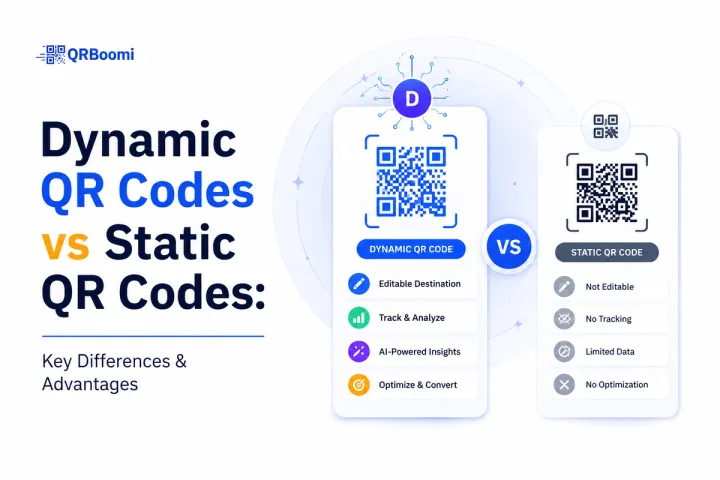
Dynamic QR codes are editable QR codes that let you change the destination URL, campaign content, or settings after the code has been printed or published. Specifically, unlike static QR codes that lock in a single destination at the point of creation, dynamic codes remain live and flexible — letting marketers update campaigns, A/B test destinations, and track full scan-to-outcome performance in real time, without reprinting a single code.
What Is a Static QR Code?
A static QR code encodes its destination directly into the pattern of the code itself. Once created, the destination — typically a URL — is permanent. Change the URL and you have a new code. The old one is dead.
Static codes are generated instantly, cost nothing to create, and work without any backend infrastructure. That simplicity is their appeal. It is also their ceiling.
Static codes offer no scan data, no campaign editing, and no ability to redirect traffic after deployment. Every printed piece that carries one becomes a fixed asset the moment it leaves the printer.
What Static QR Codes Are Used For
- One-time links: Wi-Fi credentials, app store redirects, permanent landing pages
- Non-campaign assets: Business cards, email signatures, permanent signage
- Low-stakes uses: Personal QR codes, internal documents, ephemeral handouts
What Is a Dynamic QR Code?
A dynamic QR code stores a short redirect URL in the code pattern. That redirect points to a platform (like QRBoomi) that controls the final destination. When a user scans the code, the platform reads the scan, logs data, and sends the user to wherever the campaign is currently pointed.
This means the physical code never needs to change. The campaign behind it can change as often as you need.
Across QRBoomi campaigns, this single capability — the ability to redirect, refresh, and retarget without reprinting — has driven meaningful reductions in campaign production costs and meaningful increases in scan-to-conversion rates. The code stays. The campaign evolves.
What Dynamic QR Codes Are Used For
- Packaging campaigns: Redirect scans from existing product inventory to new promotions
- Retail and hospitality: Update menus, offers, and events in real time
- Events and experiential: Track scan volumes by location and drive post-event follow-up
- Phygital marketing: Connect print, OOH, and physical touchpoints to measurable digital funnels
- Agency and multi-location campaigns: Run and report across dozens of codes from one dashboard
Head-to-Head: Dynamic vs Static QR Codes
Here is the campaign-level breakdown of how these two code types actually differ where it matters.
The Advantages of Dynamic QR Codes for Campaign Marketers
The comparison table above shows the what. This section explains the why — why dynamic codes are not just technically superior, but strategically necessary for any brand running QR as part of a real marketing programme.
1. You Can Fix a Live Campaign Without Reprinting
In physical marketing, mistakes are expensive. A mistyped URL on 10,000 flyers means 10,000 dead codes and a reprint bill. With dynamic codes, you fix the destination in your platform dashboard. The printed codes keep working.
We have seen QRBoomi users catch destination errors mid-campaign — after print runs — and redirect codes within minutes. That kind of control is not possible with static codes at any price.
2. You Get Scan Data That Actually Means Something
Static codes are analytics black holes. Dynamic codes feed you data: total scans, unique scans, device type, location, time of day, and conversion events if your destination is set up to receive them.
Every scan is a data point. Across a campaign with thousands of physical touchpoints, that data is not just interesting — it is the attribution proof that connects your print spend to digital outcomes. That is the foundation of scan-to-outcome measurement.
3. You Can A/B Test Destinations Post-Print
Imagine running two versions of a landing page and routing your QR traffic 50/50 to test which converts better. With dynamic codes, you do this from a dashboard — no new codes, no reprinting, no separate campaigns.
This is standard practice in digital advertising. Dynamic QR codes bring it to physical media.
4. One Code, Multiple Campaign Phases
A package printed in January can run a New Year campaign, a Valentine's campaign, a spring promotion, and a loyalty programme — all from the same QR code. You update the destination. The physical asset remains identical.
For brands with long shelf lives — food and beverage, consumer goods, hospitality — this is not a convenience. It is a fundamental shift in how physical marketing ROI is calculated.
5. Branded Codes That People Actually Scan
Dynamic codes are served through a platform, which means they are also designed through a platform. QRBoomi lets you apply custom colors, brand logos, and on-design shapes to every code.
Branded QR codes consistently outperform plain black-and-white codes on scan rate. The code looks like it belongs — not like an afterthought. That visual trust is a conversion factor most brands overlook entirely.
When Static QR Codes Actually Make Sense
QRBoomi is a campaign platform, and campaigns need dynamic codes. But we will give you the honest answer here: static codes have legitimate uses.
Use Static Codes When:
- The destination will never change and you never need scan data
- You are connecting to a Wi-Fi network or a vCard — content that is inherently static
- The asset is truly one-time and ephemeral (a conference handout, an internal test)
- You have no campaign management infrastructure and the code will be retired in days
The moment any of the following is true, static codes stop being appropriate:
- You want to know how many people scanned
- The destination URL might change
- The code will be printed in volume or used across multiple locations
- You need to report campaign performance to anyone
If you can see your campaign evolving — if there is any chance you will need to update it, measure it, or improve it — you need a dynamic code from the start. Switching from static to dynamic mid-campaign means creating a new code and reprinting everything.
The QRBoomi Scan-to-Outcome Framework
Most QR campaigns are built backwards. Brands choose a code type, print it, and then ask how they will measure it. The QRBoomi Scan-to-Outcome Framework starts from measurement and works back to execution.
The Four Stages
- Define the outcome before choosing the code type. What should a scan produce? A lead capture? A menu view? A loyalty sign-up? The answer determines the campaign architecture.
- Choose dynamic if the outcome needs tracking or flexibility — which is most campaigns.
- Design the destination before printing the code. The code is the bridge. The landing page is the campaign.
- Measure scan-to-outcome, not scan volume. Volume tells you the code worked. Outcome tells you the campaign worked.
Across QRBoomi campaigns, brands that define their scan-to-outcome before launch consistently outperform those that treat QR as an afterthought. The framework is simple because the principle is simple: a QR code is not a campaign. A campaign is.
Key Takeaways
- Static QR codes lock in a destination at creation. They cannot be changed, tracked, or updated after printing.
- Dynamic QR codes redirect through a platform, allowing you to update destinations, track scans, and run campaign analytics without touching the physical code.
- The performance gap between static and dynamic codes widens with campaign complexity. The more locations, the longer the shelf life, the higher the print volume — the more dynamic codes matter.
- Scan data from dynamic codes enables scan-to-outcome attribution: connecting physical touchpoints to measurable digital results.
- Static codes have legitimate uses for permanent, non-campaign assets. For anything that needs to perform as a campaign asset, dynamic codes are the only viable choice.
- Branded dynamic QR codes consistently produce higher scan rates than generic black-and-white codes.
- Use the Scan-to-Outcome Framework: define what a scan should produce before you choose your code type or design your destination.
QRBoomi POV
The debate between static and dynamic QR codes is really a debate between static and dynamic thinking. Static codes are a tool. Dynamic codes are a campaign infrastructure. At QRBoomi, we believe every physical touchpoint is an unmeasured campaign waiting to be activated — and the moment you start treating QR codes as tracked, editable, branded assets rather than one-off redirects, your entire relationship with physical marketing changes. Offline meets online when the code in someone's hand is connected to the campaign in your dashboard. That connection is what we build.
Start Running QR as a Campaign
If your QR codes are getting scans but delivering no campaign insight, that is not a code problem. It is a campaign design problem. QRBoomi gives you the dynamic, trackable, branded infrastructure to fix it — without reprinting a thing.
Frequently Asked Questions
A static QR code encodes its destination directly and permanently. A dynamic QR code routes through a platform redirect, letting you update the destination, track scans, and manage the campaign after the code has been printed or published. The physical code remains the same; only the campaign behind it changes.
No. Static codes are fixed at creation. To run a dynamic campaign, you need to create a new dynamic code from the start. If you have already printed static codes, you will need to reprint. This is one of the most common and costly mistakes marketers make — switching to dynamic after production.
Dynamic codes do not expire by design — they remain active as long as your campaign platform account is live. Some platforms allow you to set expiry dates for campaign phases, but the code infrastructure itself remains intact. QRBoomi keeps codes active for the life of your account.
Dynamic QR codes require a campaign platform subscription. However, the elimination of reprinting costs — and the ROI of scan-to-outcome data — typically more than offsets the platform cost for any campaign running at volume. The real cost comparison is code tool vs campaign infrastructure.
Dynamic QR codes tracked through a platform like QRBoomi capture scan volume, unique scans, device type, location, and time. To track scan-to-outcome conversion, your destination page needs to pass conversion events back to the platform or your analytics stack via UTM parameters or API integration.
A branded QR code applies custom colors, logos, and design to the standard QR pattern. Branded codes consistently outperform generic black-and-white codes on scan rate because they look intentional and trustworthy, not like an afterthought. QRBoomi provides full branded QR design within the campaign platform.
Use static codes only for permanent, non-campaign assets where you will never need to update the destination or measure scans: Wi-Fi credentials, vCards, or one-time internal documents. Any QR code that will appear on printed marketing material in volume should be dynamic from the start.