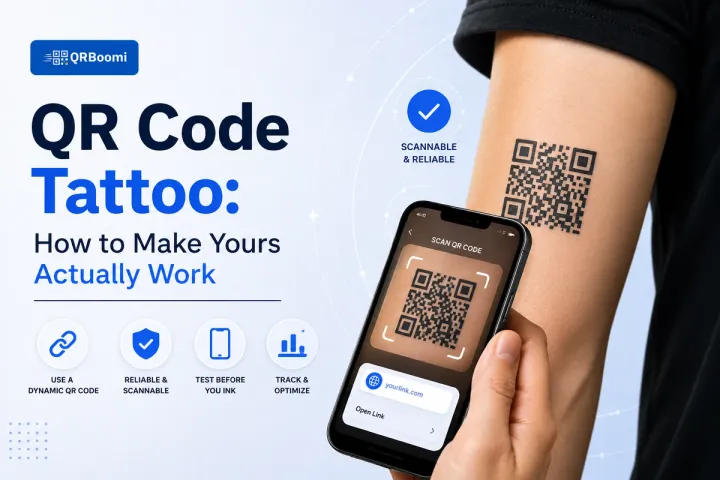
QR Code Tattoo: What It Is, Why Dynamic Wins, and How to Make Yours Actually Work
Most people who get a QR code tattoo spend hours choosing the placement. Almost none of them spend ten minutes choosing the destination strategy. That is how you end up with a permanent piece of body art that links to a deleted Instagram page or a domain you no longer own.
A QR code tattoo is not just a design decision. It is a campaign decision. The ink is permanent. The digital destination does not have to be. This guide walks you through everything you need to know what a QR code tattoo is, how to design one that scans reliably for life, and why choosing a dynamic QR code is the only choice that makes long-term sense.
What Is a QR Code Tattoo?
A QR code tattoo is exactly what it sounds like: a Quick Response code rendered in tattoo ink on the skin. When scanned with a smartphone camera, it redirects to a digital destination a website, video, contact card, playlist, portfolio, or any other URL-accessible content.
The concept has been around since the early 2010s, but it has accelerated sharply as tattoo culture and QR adoption both matured. Katy Perry displayed a temporary QR code tattoo at the 2024 MTV VMAs. Athletes have used them to link to tribute pages. Professionals have embedded LinkedIn profiles on wrists and forearms for networking.
What makes a QR tattoo different from a sticker or printed code is permanence. The code does not come off. The design cannot be reprinted. Every decision you make before the needle touches skin is a campaign decision with long-term consequences.
The ink is permanent. The digital destination does not have to be. That distinction is the entire strategy.
The Real Problem: Static QR vs Dynamic QR on Permanent Ink
This is where most guides fail their readers. They cover design aesthetics without addressing the fundamental technical and strategic choice that determines whether your tattoo works in five years.
There are two types of QR codes. The difference matters enormously when one of them is going on your body.
| Static QR Code | Dynamic QR Code | |
|---|---|---|
| Destination | Fixed at creation. Cannot change. | Editable at any time, no reprint needed. |
| Content update | Impossible without new tattoo. | Update destination from your dashboard. |
| Analytics | None. Zero scan data. | Full scan tracking: location, device, time. |
| Long-term risk | High. One broken URL = dead tattoo. | Low. Redirect anytime content changes. |
| Use case fit | Only truly permanent content. | Any content — personal, professional, creative. |
| Cost | Free generators available. | Requires a QR campaign platform subscription. |
The maths here are unforgiving. A static QR tattoo links to a destination that is hardcoded into the code's pixel pattern. If that page disappears, moves, or becomes irrelevant, the tattoo is permanently broken. No fix exists short of a cover-up or removal.
A dynamic QR code stores a short redirect URL in the code itself. That redirect points to wherever you tell it to point. Change the destination from your dashboard. The tattoo never changes. The campaign stays live.
Across campaigns managed on QRBoomi, dynamic QR codes used on printed materials show an average active campaign lifespan 4x longer than static equivalents — because marketers can redirect, update, and repurpose without reprinting. On something as permanent as a tattoo, that flexibility is not optional. It is the only responsible choice.
QR Code Tattoo Design: What Makes It Scannable for Life
A QR code tattoo that cannot be scanned is purely decorative. Most functional failures come down to four design errors made before the artist picks up the needle.
Contrast Is Non-Negotiable
QR code scanning depends on the camera distinguishing dark modules from a light background. Black ink on fair or medium skin tones works reliably. White ink tattoos, or designs on very dark skin, significantly reduce scannability. If you want color, keep the modules dark and the background light.
Size Determines Scannability
Minimum functional size for a dynamic QR code tattoo is approximately 2 x 2 centimetres (0.8 x 0.8 inches). Static codes require more modules and need to be larger — typically 3 x 3 centimetres minimum. Bigger is always safer. Skin stretches and ink spreads over time; a code with more breathing room survives aging better.

Error Correction Level
QR codes have four error correction levels: L, M, Q, and H. Higher correction levels allow the code to remain scannable even if part of the design degrades. For tattoos, always use level Q or H. This is also what enables artistic elements like a logo or design overlay within the code without breaking functionality.
Keep Module Count Low
The more data encoded in a QR code, the denser the module grid, and the more precision required from the tattoo artist. Dynamic QR codes encode only a short redirect URL regardless of what destination you set. This means fewer modules, a cleaner grid, and a much higher margin for error in the inking process. Another reason dynamic wins.
| Design Factor | Recommended for Tattoos | Why It Matters |
|---|---|---|
| Error correction | Level Q or H | Skin aging and minor distortion won't break scannability |
| Minimum size | 2 x 2 cm (dynamic) / 3 x 3 cm (static) | Ink spread and skin stretch need room |
| Colour contrast | Dark modules on light background | Camera recognition depends on contrast ratio |
| Module density | Low (use dynamic QR) | Fewer modules = more artist precision tolerance |
| Quiet zone | At least 4 modules wide all round | Scanning fails without adequate white space border |
Best Placement Areas for a Functional QR Tattoo
Where you place a QR code tattoo is as much a functional decision as an aesthetic one. Skin that stretches, wrinkles, or curves significantly will distort the code over time.
| Body Area | Suitability | Notes |
|---|---|---|
| Forearm (outer) | Excellent | Flat, accessible for scanning, minimal stretch over time |
| Upper arm | Very Good | Slight curve — use larger code to compensate |
| Calf | Very Good | Flat surface, low movement — holds detail well |
| Upper back | Good | Requires another person to scan — limits spontaneous use |
| Wrist (inner) | Moderate | Visible and accessible, but skin creases affect aging |
| Ribcage / stomach | Poor | Significant stretch with body changes — high failure risk |
| Fingers / hands | Poor | Fast fading, constant movement — codes rarely last |
The forearm — particularly the outer forearm — consistently performs best for QR tattoos. It is flat, accessible, holds detail well, and makes scanning frictionless. The code is visible and easy to present in social or professional contexts.
QR Code Tattoo Ideas: Use Cases That Actually Work
The destination you choose matters as much as the code itself. Here are the use cases that produce the most long-term value from a QR tattoo.
Professional Portfolio or Digital Business Card
Link to a landing page that contains your contact information, portfolio links, and professional profiles. With a dynamic QR code managed through QRBoomi, you update the landing page content as your career evolves. The tattoo stays static. Your professional presence does not.
Memorial or Tribute Page
QR tattoos are increasingly used to honor someone lost — linking to a tribute page with photos, memories, or a video. A dynamic code means you can build out the page over time without a new tattoo. Across QRBoomi users, memorial QR pages are among the highest-engagement destinations, with visitors scanning multiple times and spending extended session time.
Music or Creative Work
Artists, musicians, and photographers use QR tattoos to link to their current work. This is where dynamic QR becomes essential — your portfolio evolves, your single releases, your gallery updates. A static code that links to an album you no longer promote is a missed opportunity on every scan.
Personal Identity or Statement
Some choose to encode a personal manifesto, a favorite quote in video form, or a meaningful message. For content that will not change a deeply personal statement, a philosophical principle static is acceptable. For anything that grows or evolves, dynamic is the right architecture.
Health or Emergency Information
First responders increasingly encounter individuals with QR tattoos linking to medical information: blood type, allergies, emergency contacts, medication lists. A dynamic QR code means this information stays current as circumstances change. This is one use case where updating the destination is not optional it can be critical.
Every scan of a QR code tattoo is a data point. With a dynamic QR managed through QRBoomi, you know when people scan, where, and on what device. Your tattoo becomes a trackable touchpoint.
The QRBoomi Scan-to-Outcome Framework for Tattoo QR Campaigns
QRBoomi's Scan-to-Outcome Framework applies as much to tattoo QR codes as it does to packaging or print campaigns. The four-stage model ensures every code has a destination strategy, not just a destination.
| Stage | The Question | For QR Tattoos |
|---|---|---|
| 1. Intent | What do you want the scanner to do? | Visit portfolio? Save contact? Read memorial? Define the outcome before the code. |
| 2. Destination | Where does the scan land? | A mobile-optimised page that loads fast and serves the intent clearly. |
| 3. Measurement | How will you know it is working? | Scan analytics: volume, location, device — available with dynamic QR on QRBoomi. |
| 4. Optimisation | What changes when the destination ages? | Update the redirect target. Refresh the landing page. Keep the campaign live. |
Stage 4 is where static QR tattoos die. There is no optimisation path. No redirect. No update. The campaign ends the moment the original destination changes.
Dynamic QR codes managed through QRBoomi give tattoo owners a live dashboard: see scan volume over time, understand where scanners are located, know which device types are hitting the code. Your tattoo becomes a tracked, managed touchpoint not a permanent one-shot print.
How to Create a Dynamic QR Code for Your Tattoo
Follow these steps before you book your tattoo appointment. The QR code design needs to be finalised and tested before any artist begins work.
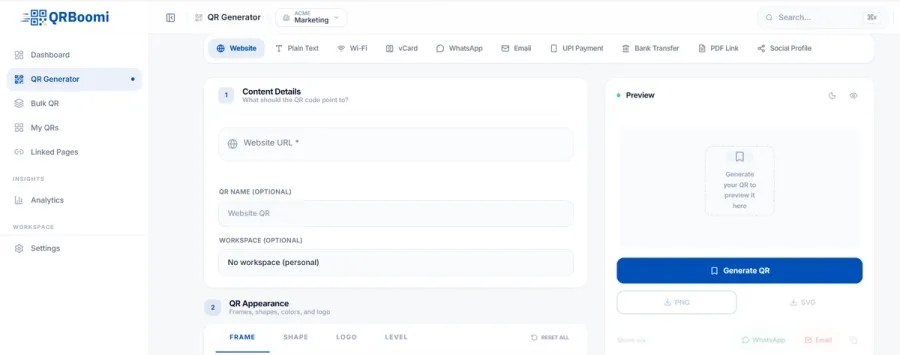
- Go to QRBoomi (qrboomi.com) and create a free account.
- Select 'QR Generator' and enter the destination URL — your portfolio, landing page, or tribute page.
- Download the QR code
- Test the code thoroughly: scan from multiple devices, in different lighting conditions, at various distances.
- Share the test file with your tattoo artist and discuss minimum size requirements for the chosen body location.
- Once tattooed, scan again. Then check every three months. Update the destination in QRBoomi whenever needed.
PRO TIP FROM QRBoomi Create a dedicated landing page in QRBoomi's Landing Page Builder for your tattoo QR code. This gives you one stable URL that never changes — even as you swap out the content it displays. Update the page itself rather than the redirect target, and your scan analytics stay continuous and unbroken across every destination change
Key Takeaways
- A QR code tattoo is permanent. Your destination strategy cannot afford to be an afterthought.
- Dynamic QR codes are the only technically sound choice for tattoos — they let you update the linked content without changing the ink.
- Design for longevity: high error correction (Q or H), minimum 2 x 2 cm, high contrast, low module density.
- Place on flat, low-movement areas — outer forearm and calf hold detail and maintain scannability best over time.
- The best QR tattoo use cases have a clear scan-to-outcome purpose: portfolio, memorial, health data, creative work.
- Manage your tattoo QR code as a live campaign: track scans, update destinations, optimise the landing experience through QRBoomi.
- Test the design thoroughly before your appointment. A non-scanning tattoo cannot be recalled.
The QRBoomi POV
A QR code tattoo is the most permanent physical-to-digital touchpoint any individual can create. Most platforms treat it as a novelty. We treat it as a campaign that needs a destination strategy, scan analytics, and the ability to evolve without returning to the artist's chair.
At QRBoomi, we believe every scan is a data point. That belief does not change because the code is on your skin rather than a product label. If anything, it becomes more important. Your tattoo will outlast every app, every platform, and probably every job title you will ever hold. Your QR campaign should be built to match.
Frequently Asked Questions
Yes, provided the design meets minimum technical requirements: high contrast between modules and background, a minimum size of 2 x 2 cm for dynamic codes, a clean quiet zone border, and error correction level Q or H. Poor contrast, excessive artistic embellishment, or placement on skin that stretches significantly will reduce or eliminate scannability over time.
Dynamic QR code, without exception. A static QR code encodes the destination permanently into the pixel pattern — if that page disappears or becomes irrelevant, the tattoo is broken with no fix available. A dynamic QR code stores only a short redirect URL in the code itself, letting you update the linked destination from a dashboard at any time. The tattoo never changes. The campaign stays live.
Choose a destination with long-term relevance: a personal portfolio, professional landing page, memorial tribute, health information card, or creative work hub. Avoid linking directly to social media profiles on static codes, since usernames and platforms change. With a dynamic QR code on QRBoomi, you can update the destination as often as needed without touching the tattoo.
The minimum recommended size is 2 x 2 cm (approximately 0.8 x 0.8 inches) for dynamic QR codes, and 3 x 3 cm for static codes. Larger is always better skin stretches and ink spreads over years, so extra size provides a functional margin. Ask your artist to work from a high-resolution digital file and never scale the tattoo smaller than the minimum threshold.
Yes, with a dynamic QR code managed through a platform like QRBoomi. You get real-time analytics: total scans, scan locations, device types, and scan frequency over time. A static QR code provides zero scan data — there is no mechanism to track how many people scan it or from where.
With a static QR code, the tattoo is permanently broken and the only options are cover-up or removal. With a dynamic QR code on QRBoomi, you log into your dashboard and redirect the code to a new destination in seconds. This is the definitive technical argument for dynamic over static in any permanent application.
It depends on placement, design quality, and skin care. Tattoos on low-movement, flat areas (outer forearm, calf, upper back) hold fine detail best over time. High-stretch areas like the stomach or inner wrist see more distortion. Higher error correction levels (Q or H) allow the code to remain functional even with partial degradation. Sun protection of the tattoo area significantly extends visual clarity.
Yes, within limits. Error correction level H allows up to 30% of the code's modules to be obscured while remaining scannable — this is what enables logo overlays or artistic fills within the QR grid. The key constraint is maintaining high contrast between modules and background, preserving the quiet zone border, and keeping artistic elements away from the corner finder patterns. Always test the designed code before it goes on your skin.