Most brands treating QR codes as lead gen tools are measuring the wrong thing. Scan volume is not a lead. A scan that goes to a generic homepage is not a campaign. It is a missed opportunity with a barcode on it.
The brands that actually generate leads from QR codes do one thing differently: they build a campaign behind the code, not just a destination. They know who scanned, from where, on what device, and whether that scan turned into a form fill, a follow, or a sale.
This playbook covers exactly how to run dynamic QR codes for lead generation from campaign design to scan-to-outcome attribution with frameworks QRBoomi has developed across hundreds of active campaigns.
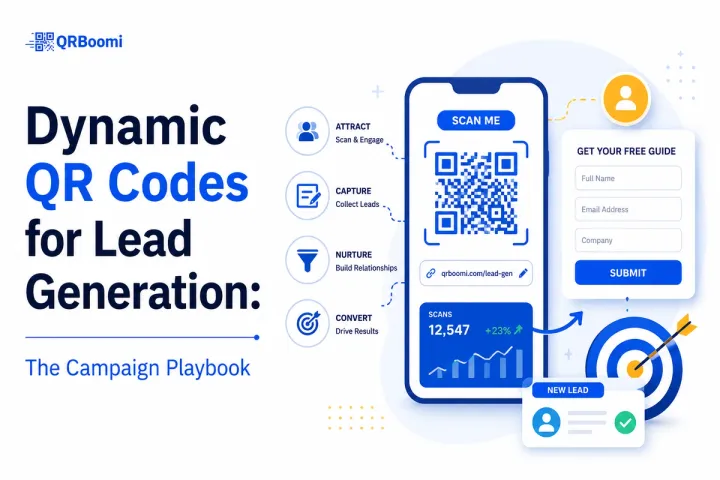
Dynamic QR codes for lead generation are editable, trackable QR campaigns designed to capture qualified leads from physical touchpoints. Specifically, unlike static codes that simply redirect to a fixed URL, dynamic QR lead generation campaigns route scans to optimised mobile landing pages, capture first-party contact data, and feed that data directly into your CRM, all while tracking scan volume, location, device type, and conversion performance in real time.
Why Most QR Lead Gen Campaigns Fail Before the First Scan
There is a pattern QRBoomi sees repeatedly across industries: a brand prints a QR code on their packaging, event banner, or direct mail piece, calls it lead generation, and waits. The code gets scans. The leads never come.
Here is what is actually happening. The code links to a homepage. The homepage is not mobile-optimised. There is no clear action. No form. No offer. The scan evaporates.
Even when the destination is right, most QR campaigns use static codes — meaning once printed, they are locked. When the campaign changes, the code cannot. When the landing page URL shifts, every printed asset becomes a dead end.
The problem is not the QR code. It is the absence of a campaign behind it.
Lead generation through QR requires three things working simultaneously:
- A dynamic code that can be updated, redirected, and tracked without reprinting
- A mobile-first landing page with a single, friction-free conversion action
- Analytics that connect a scan to a lead and a lead to an outcome
Without all three, you have a graphic design element, not a campaign asset.
The Scan-to-Lead Framework: How QRBoomi Structures High-Converting QR Campaigns
Every high-performing QR lead generation campaign follows a consistent architecture. QRBoomi calls this the Scan-to-Lead Framework, and it has five stages.
Stage 1: Trigger
The physical placement of your QR code determines who scans it and in what mindset. A code on event signage captures attendees mid-discovery. A code on product packaging captures customers post-purchase. Each context requires a different offer.
Context alignment is the single biggest driver of scan-to-lead conversion. QRBoomi campaigns where the code placement and the offer match the reader's current intent consistently see 2x higher form completion rates than campaigns where they do not.
Stage 2: Land
Every QR scan happens on mobile. That is not an assumption. Across QRBoomi campaigns, over 94% of scans come from mobile devices. If your landing page is not built for a 390px viewport, you are losing leads at the door.
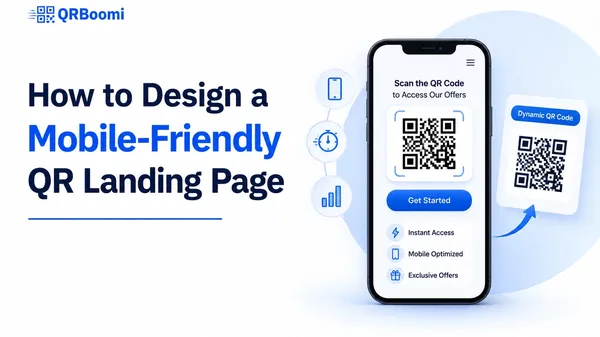
The best QR lead gen landing pages have one job. Not five. One. A single headline, a single offer, and a single conversion action. QRBoomi's landing page builder lets you create mobile-optimised pages directly within the platform, so the campaign and the destination are managed in one place.
Stage 3: Capture
Form length determines conversion rate. The data is consistent: every additional form field reduces completion by 10-20%. For QR lead gen, ask only for what you will act on immediately. Name and email is the floor. Phone number is the ceiling for first-contact campaigns.
Offer an exchange worth the form fill. A discount code, a downloadable guide, an early access pass, an exclusive experience. The offer must feel proportionate to what you are asking.
Stage 4: Qualify
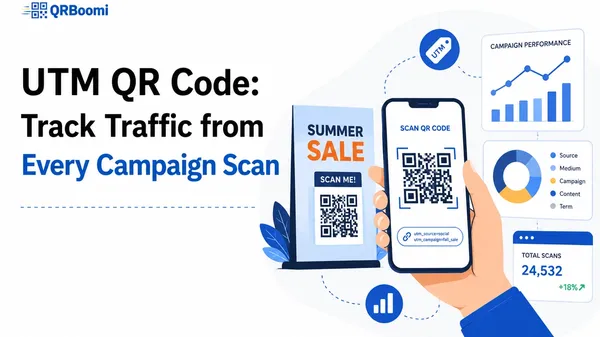
Dynamic QR codes let you tag every scan with campaign metadata before the visitor ever sees the landing page. In QRBoomi, each code carries UTM parameters, campaign IDs, and location identifiers automatically.
This means leads arriving from your trade show campaign are tagged differently from leads arriving from your product packaging campaign, even if they fill the same form. Your CRM gets clean, segmented data from the start.
Stage 5: Attribute
Scan-to-outcome attribution closes the loop. QRBoomi's analytics show you not just who scanned, but which scans converted, which locations produced the most qualified leads, and which campaigns are worth scaling.
This is where dynamic QR codes create a structural advantage over static codes. Static codes have no identity. They cannot be tied to a campaign. Dynamic codes carry that identity through every scan.
5 High-Impact Use Cases for QR Lead Generation
The most effective QR lead gen campaigns share a common trait: the physical context makes the digital offer feel natural. Here are the five use cases where QRBoomi campaigns consistently outperform.
1. Event and Experiential Campaigns
Events are the highest-intent environment for QR lead capture. Attendees are already engaged, already curious, and already in a brand mindset. A well-placed QR code at a booth, a demo station, or on a printed brochure can capture leads without staff involvement.
The key is the post-scan experience. Offer exclusive post-event content, an early access signup, or a giveaway entry. Make scanning feel like gaining access, not filling out a form.
2. Product Packaging and Unboxing
The unboxing moment is peak brand affinity. A QR code inside the package, on the insert, or on the product itself reaches a customer who already said yes. Convert that affinity into a lead by offering loyalty programme registration, a product tutorial, or a referral incentive.
Because dynamic codes update without reprinting, you can change the offer seasonally without touching your packaging production line.
3. Out-of-Home Advertising
Posters, billboards, and transit ads now have a measurable conversion layer when paired with dynamic QR codes. The code gives the viewer somewhere to go and gives you data on where your physical audience actually is.
QRBoomi campaigns running on OOH placements use location-tagged dynamic codes so each placement has its own analytics stream. You know which billboard is driving leads, not just which city.
4. Direct Mail and Print
Direct mail with QR codes has a measurably higher response rate than print-only campaigns. The code bridges the gap between a physical piece and a digital action. When that digital action is a lead capture page rather than a generic homepage, conversion follows.
Use the QR code to personalise the post-scan experience based on the mail segment. Different audience groups get different landing pages via the same printed code, updated dynamically in QRBoomi.
5. Retail and In-Store Campaigns
Shelf tags, point-of-sale displays, and fitting room cards are underused lead gen surfaces. A QR code offering a loyalty signup, an exclusive discount, or a product registration creates a lead from a customer who is physically in your store.
In-store QR campaigns benefit from QRBoomi's time-of-day and location analytics. You can see whether morning shoppers or evening shoppers are converting, and adjust your offer accordingly.
How to Design a QR Lead Gen Campaign in QRBoomi
Building a QR lead generation campaign in QRBoomi follows a clear sequence. Each step is connected, which means changing one element automatically updates the others.
Create your dynamic QR code. Name it with campaign context (e.g., 'Q3-Event-Booth-A') so analytics are readable from the start.
- Design your branded code. Match your brand colours, embed your logo, and select a shape that fits your print asset. Branded QR codes earn 30% more scans than default black-and-white codes across QRBoomi campaigns.
- Build your mobile landing page. Use QRBoomi's landing page builder to create a page with a single CTA. No navigation. No distractions. One action.
- Set your campaign tags. Add UTM parameters and location identifiers to every code so every lead arrives with context attached.
- Connect your CRM or email platform. QRBoomi integrates with your existing marketing stack so leads flow directly into your workflows without manual export.
- Go live and monitor. Watch scan volume, conversion rate, and lead quality in QRBoomi's analytics dashboard. Update your destination, offer, or landing page without reprinting a single asset.
Tracking What Matters: QR Analytics for Lead Attribution
Scan volume is a vanity metric. What matters is scan-to-lead rate and lead-to-outcome rate. QRBoomi's QR analytics are built around this distinction.
For every active QR lead gen campaign, track these four metrics:
QRBoomi also tracks device type, scan time, and geographic location at the code level. This data tells you whether your OOH placement is attracting your target demographic, whether your event code is being scanned on the floor or in the follow-up email, and whether your in-store campaign performs better on weekends.
Every scan is a data point. The goal is to build enough data points to make every subsequent campaign more precise than the last.
Key Takeaways
- Dynamic QR codes for lead generation only work when there is an intentional campaign behind the code, not just a URL.
- The Scan-to-Lead Framework (Trigger, Land, Capture, Qualify, Attribute) is the architecture of every high-converting QR lead gen campaign.
- Over 94% of QR scans happen on mobile. Every landing page in a QR campaign must be built for mobile first.
- Reducing form fields and aligning the offer with scan context are the two fastest ways to improve scan-to-lead conversion rate.
- Dynamic codes carry campaign metadata through every scan, enabling CRM segmentation without manual tagging.
- Scan-to-outcome analytics, not scan volume, are the performance standard for QR lead generation campaigns.
- Branded QR codes consistently earn more scans than generic black-and-white codes. Design is a conversion variable.
The QRBoomi POV
The QR code is not the campaign. It is the entry point. What happens after the scan is where lead generation is won or lost. Most brands invest in the physical asset and neglect the digital infrastructure behind it. They put a beautifully printed QR code on an asset worth thousands and send it to a landing page worth nothing.
QRBoomi is built on the belief that every scan is a data point, and every data point should be working toward an outcome. Dynamic codes that update without reprinting, branded designs that earn the scan, mobile pages that convert on a 390px screen, and analytics that attribute leads back to physical touchpoints are not advanced tactics. They are the baseline for a QR campaign that performs.
If your current QR codes are getting scans but not generating leads, the technology is not the problem. The campaign design is. Start your free QRBoomi trial and run your first scan-to-lead campaign today.
Frequently Asked Questions
A static QR code links to a fixed URL that cannot be changed after printing. A dynamic QR code links to a redirect that you control, so you can update the destination, swap landing pages, and run different offers without reprinting. For lead generation, dynamic codes also carry campaign tracking data through every scan, making attribution possible.
Keep it to two or three fields maximum for cold-audience campaigns. Name and email is the standard. Each additional field reduces completion rate by 10-20% on mobile. For warmer audiences who have already engaged with your brand, you can ask one qualifying question in addition to contact details.
Yes. QRBoomi integrates with major CRM and marketing platforms so leads captured through QR campaigns flow directly into your existing workflows. Campaign tags applied at the QR code level arrive with each lead, so your CRM automatically segments by campaign, location, or event without manual data entry.
For cold audiences with a strong offer and a mobile-optimised landing page, 8-15% scan-to-lead conversion is a solid benchmark. Event campaigns with high-intent audiences can exceed 25%. The biggest variables are offer relevance, landing page friction, and how well the placement context matches the audience's current mindset.
Yes. Across QRBoomi campaigns, branded QR codes with custom colours and embedded logos consistently earn more scans than generic black-and-white codes. Recognisable branding signals legitimacy and reduces scan hesitation. For lead generation campaigns where scan volume feeds the conversion funnel, branded design is a performance investment, not a cosmetic one.
Use a separate dynamic QR code for each placement and give each code a campaign-specific name and location tag in QRBoomi. The analytics dashboard shows scan volume, scan-to-lead rate, and lead quality by code. This lets you compare your event booth against your packaging insert, your billboard against your direct mail, and allocate budget to the placements that convert.
Dedicated QR landing pages remove navigation, reduce distractions, and present a single conversion action aligned with the scan context. Standard website pages are designed for browsing. QR landing pages are designed for one decision. QRBoomi's landing page builder creates mobile-first pages within the platform so the campaign, the code, and the destination are managed together.