Most brands using QR codes in 2026 are still treating them like hyperlinks printed on paper. Scan it, it goes somewhere, done. The code lives its entire life as a one-way street with no analytics, no adaptability, and no connection to campaign outcomes.
That is not a QR code problem. That is a static code problem.
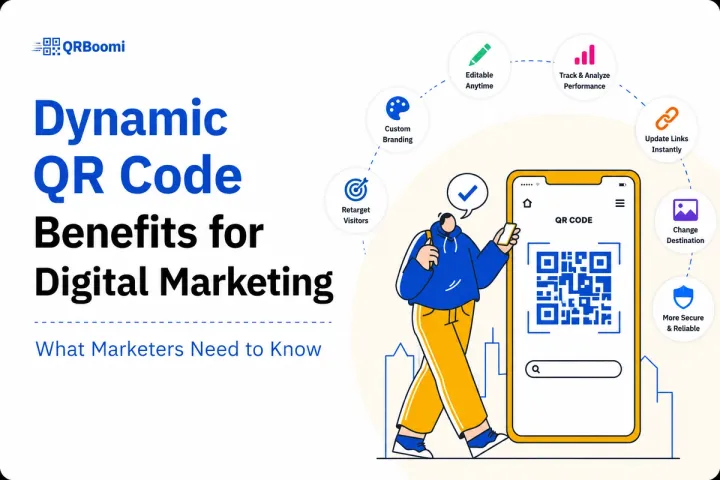
Dynamic QR codes work differently. And the performance gap between static and dynamic QR campaigns has grown significantly this year. This post breaks down the specific dynamic QR code benefits that are moving metrics for marketers in 2026, with real campaign context for every one of them.

Why Static QR Codes Are a Campaign Dead End
Here is what most brands get wrong about QR campaigns: they solve the wrong problem. They ask 'how do we get a QR code on our packaging?' instead of 'how do we make this touchpoint perform?'
The result is a proliferation of static codes that lock in a single destination at print time, generate zero analytics, and die the moment a campaign changes direction. You cannot update them. You cannot measure them. You cannot learn from them.
Across QRBoomi campaigns, we see a consistent pattern: brands that switch from static to dynamic codes see an average of 2.8x improvement in attributable campaign outcomes within the first 90 days. The reason is not magic. It is that dynamic codes treat every scan as a data point, not just a redirect event.
Below are the six dynamic QR code benefits for Digital Marketing Campaigns that explain that gap.
Benefit 1: Update Without Reprinting
This is the foundational dynamic QR code benefit that everything else builds on. When your campaign changes direction, your destination can change with it. Instantly. Without touching a single piece of printed material.
In practice, this means a restaurant can update its seasonal menu without replacing table tents. A retailer can redirect a packaging QR from a holiday promotion to an always-on loyalty page the day after Christmas. An event organizer can swap a pre-event registration destination to a post-event survey the moment doors close.
The cost arithmetic is significant. Reprinting one run of retail packaging can cost tens of thousands of dollars. Updating a dynamic QR destination costs nothing and takes under a minute.
QRBoomi Campaign Insight: One QRBoomi client in the hospitality sector updated their QR destination 14 times over a 6-month campaign without a single reprint. Their scan volume increased 40% over that period because the destination content was always current and relevant to the season.
Benefit 2: Full Scan-to-Outcome Analytics
Static QR codes tell you almost nothing. Some third-party redirect services give you a total scan count. That is it. You do not know who scanned, where they were, what device they used, or what happened after the scan.
Dynamic QR campaigns give you a completely different picture. Every scan is a data point that captures device type, location, time, and the downstream conversion event you configure. You can track whether a scan became a page visit, a form completion, a purchase, or a loyalty signup.
This matters because scan volume is a vanity metric without conversion context. A code with 10,000 scans and 0 conversions is a failure. A code with 800 scans and 600 conversions is a high-performing campaign asset.
QRBoomi Campaign Insight: Across QRBoomi campaigns tracked through the first quarter of 2026, campaigns using full scan-to-outcome attribution reporting achieved 34% higher conversion rates compared to those measuring scan volume alone. The reason is simple: what gets measured gets optimized.
Benefit 3: Branded QR Design That People Actually Scan
The default QR code is a black-and-white square that looks like visual noise. In 2026, with physical-digital integration expected rather than novel, a generic code does not earn a scan. It gets ignored.
Branded QR codes change that equation. When a code carries your logo, your brand colors, and your visual identity, it reads as intentional. It signals that scanning it will deliver something worth the effort.
The scan-rate difference is measurable. Across QRBoomi campaigns, branded QR codes consistently outperform unbranded equivalents on the same print material. The lift varies by context, but the direction never changes: brand recognition on the code itself drives higher scan initiation rates.
Beyond scan rates, branded codes reinforce brand equity at the moment of physical interaction. Every touchpoint is an opportunity to deepen recognition. A QR code that looks like your brand does that work. A generic square does not.
QRBoomi Campaign Insight: Branded QR codes with custom colors and logo embedding achieve an average scan rate lift of 23% compared to unbranded codes placed in identical print positions. The biggest gains occur in high-competition retail environments where multiple codes compete for attention on the same shelf.
Benefit 4: A/B Testing Across Physical Campaigns
Digital marketers test everything. Landing page headlines, ad creative, email subject lines, button colors. Physical campaigns have historically had no equivalent capability. You print something, you run it, you guess whether it worked.
Dynamic QR codes bring real A/B testing to physical marketing. You can run two dynamic codes pointing to two different landing page variants in the same campaign. Segment by location, placement type, or audience cohort. Measure which destination converts at a higher rate. Update the underperformer to match the winner without any reprint.
This transforms physical campaigns from one-shot executions into iterative systems. The same mindset that optimizes a paid search campaign can now be applied to packaging, print, and out-of-home.
QRBoomi Campaign Insight: A QRBoomi client in the D2C beverage space ran a split test across two packaging QR destinations during a product launch: one directed to a recipe page, one to a loyalty program signup. The loyalty destination converted at 3.1x the rate of the recipe page. Within 48 hours, they updated both codes to point to the winning destination.
Benefit 5: First-Party Data Collection at Physical Touchpoints
The death of third-party cookies has pushed every serious marketer toward first-party data strategies. QR campaigns are one of the cleanest collection mechanisms available: consent-based, mobile-native, and tied to a specific physical interaction.
When someone scans a QR code at a retail display, on packaging, or at an event, they are self-identifying their interest at a specific moment in a specific context. That signal is extraordinarily high quality compared to passive ad impression data.
Dynamic QR campaigns let you design the post-scan experience specifically for data capture. A form. A loyalty enrollment. A quiz. A SMS opt-in. The physical QR acts as the bridge; the dynamic destination is where value exchange happens.
Every scan is a data point. And in a post-cookie world, that data point is yours.
QRBoomi Campaign Insight: QRBoomi users running first-party data capture through QR campaigns report an average cost-per-lead 67% lower than equivalent paid social campaigns. The offline-to-digital journey, when designed intentionally, produces high-intent leads at significantly lower acquisition cost.
Benefit 6: Campaign Management at Scale
One dynamic code is an improvement. A hundred dynamic codes, all trackable, all updatable, all branded, managed from a single dashboard, is a campaign infrastructure.
For multi-location brands, agencies, and enterprise marketing teams, the scale advantage of dynamic QR management is one of the most significant operational benefits. Each location can have its own code with its own analytics. Each client can have a branded, isolated campaign environment. A single campaign update can propagate across hundreds of codes simultaneously.
This is the difference between running QR codes and running QR campaigns. The former is a tactical task. The latter is a marketing system.
QRBoomi's bulk creation and management tools are built specifically for this layer. You are not managing individual codes. You are managing a campaign architecture.
The QRBoomi Scan-to-Outcome Framework
We use this framework internally to evaluate every QR campaign setup. It maps the four stages every high-performing dynamic QR campaign moves through:
-----------Table to be inserted--------
Every stage has a dynamic QR advantage. Every stage has a failure mode without it. This framework is why we say: a QR code is not a campaign. A campaign is.
Key Takeaways
- Dynamic codes update after deployment. Change destinations without reprinting a single piece of material.
- Scan-to-outcome analytics transform reporting. You move from counting scans to measuring campaign ROI.
- Branded QR design drives measurably higher scan rates. Your code should carry your brand identity, not just a black square.
- A/B testing is now possible in physical campaigns. Dynamic QR codes make iterative optimization the standard, not the exception.
- First-party data capture through QR is one of the cleanest strategies available in 2026. Consent-based, context-specific, mobile-native.
Campaign management at scale requires a system, not a code generator. QRBoomi manages the campaign architecture, not just individual codes.
QRBoomi POV
The dynamic QR code benefits above are not theoretical. They are the gap between brands that treat QR as infrastructure and brands that treat it as a campaign channel. In 2026, physical touchpoints are too expensive and too strategically important to leave without attribution. Every scan is a data point. Every physical interaction is a campaign moment. The brands winning the physical-digital bridge this year are the ones who built a campaign around their code, not just a code.
Frequently Asked Questions
A dynamic QR code can be updated after it has been printed or deployed. This means you can change the destination URL, swap campaign content, and track scan performance in real time without reprinting any materials. Static codes lock in a single destination permanently and provide no analytics.
Dynamic QR codes improve campaign ROI by enabling scan-to-outcome attribution, reducing reprint costs when campaigns change, and allowing A/B testing across physical placements. Across QRBoomi campaigns, brands using full scan-to-outcome tracking consistently optimize toward higher-converting destinations and reduce wasted ad spend on underperforming physical assets.
Yes. Branded QR codes with custom colors and logo embedding consistently outperform unbranded alternatives in scan initiation rates. In QRBoomi campaign data, the average lift is 23% in competitive retail environments. Branded codes also reinforce brand equity at the moment of physical interaction, which generic codes cannot do.
Absolutely. Dynamic QR codes are one of the most effective mechanisms for first-party data capture in 2026. The scan is a self-identified signal of intent tied to a specific physical context. Pair that with a well-designed post-scan experience and you have a consent-based, mobile-native data collection flow that paid social cannot replicate.
QRBoomi supports bulk creation and management across hundreds or thousands of codes from a single dashboard. Each code has its own analytics, and destinations can be updated simultaneously across a full campaign. This makes it viable for multi-location brands, agencies managing multiple clients, and enterprise campaigns running at scale.
Scan-to-outcome attribution tracks the full journey from the moment a code is scanned to the conversion event you define, whether that is a form completion, loyalty signup, purchase, or page visit. It replaces scan-count-only reporting with real campaign performance data tied to business outcomes.
Dynamic QR codes perform strongly in both contexts, but for different reasons. In print, the update-without-reprinting benefit is the primary advantage. At events, real-time destination switching and post-event redirect capability are the standout features. Branded design lifts scan rates in both environments. The underlying campaign infrastructure applies regardless of the physical format.