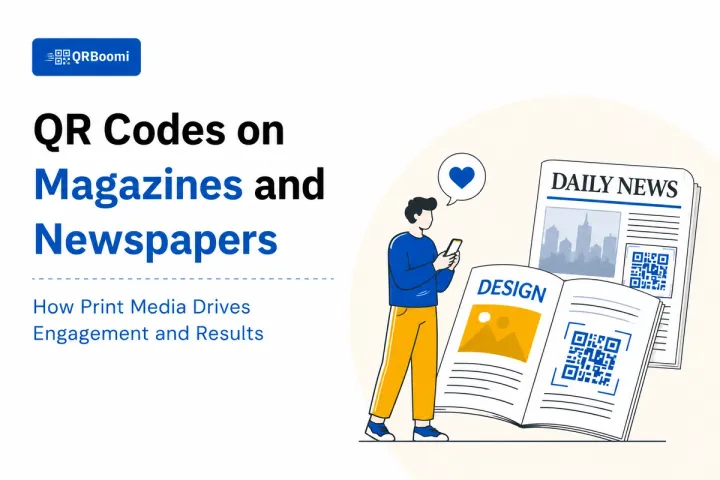
Most print QR codes are broken campaigns in disguise.
Not broken in the technical sense. The code scans. The page loads. But the campaign? It has no analytics, no second destination, no way to optimize mid-run, and no connection to any outcome the marketing team actually cares about. The code is doing its job. The campaign is not.
Print still reaches audiences that digital cannot. Magazines and newspapers command a depth of attention that no social feed can match. The readers who sit with a print publication are primed to act. If your QR code in that space is a static redirect pointing to a homepage, you are leaving qualified intent on the table.
This playbook covers how to run QR campaigns in print media the right way: dynamic, tracked, conversion-oriented, and built to improve after the ink dries.
QR codes in magazines and newspapers are scannable campaign assets embedded in print media that bridge offline readers to digital destinations. Specifically, when powered by dynamic QR technology, print QR codes let marketers update destination URLs, track scan performance by edition or placement, and attribute reader engagement to real campaign outcomes — all without reprinting the code.
Why Most Print QR Campaigns Fail Before the Magazine Hits Stands
Print has a lead time problem. By the time a magazine with your campaign reaches newsstands or subscribers, weeks may have passed since you finalized the content. Promotions end. Stock runs out. Campaign priorities shift. A static QR code pointing to a landing page that no longer reflects the current offer is not a campaign asset. It is a broken promise to a reader who just picked up their phone.
Across QRBoomi campaigns, we see three failure patterns repeat consistently in print:
- The destination is outdated by the time readers scan it.
- There is no tracking, so the brand cannot report on campaign performance.
- The post-scan experience is not built for the reader's mindset — a magazine reader who scans is curious and engaged, not in a checkout mindset. Sending them to a product grid is a missed opportunity.
None of these are print problems. They are campaign design problems. And they are entirely solvable with the right approach.
Static vs Dynamic QR Codes in Print: The Performance Gap
This is the most important decision you will make in a print QR campaign, and most brands make it wrong by default.
| Dimension | Static QR Code |
|---|---|
| Destination URL | Locked at creation — cannot change after printing |
| Mid-campaign changes | Requires reprinting the entire run |
| Analytics | Scan count only, if tracked at all |
| A/B testing | Not possible |
| Campaign lifecycle | One-off — campaign ends when print run ends |
| Error recovery | Destination error = dead campaign |
The data is consistent: dynamic QR codes in print generate more actionable campaign data and allow marketers to optimize post-publication in ways static codes simply cannot support. The upfront effort is identical. The campaign outcomes are not.
The Scan-to-Outcome Framework for Print Campaigns
Most brands measure QR success by scan volume. That is the wrong metric. A reader who scans and bounces in two seconds has not engaged with your campaign. The metric that matters is scan-to-outcome: what percentage of scanners completed the intended action?
The QRBoomi Scan-to-Outcome Framework for print breaks a campaign into four stages:
Stage 1: Trigger (The Code in Print)
The QR code must be placed, sized, and contextualized correctly. It needs a call to action in the surrounding copy — 'Scan to see it move', 'Scan for the exclusive offer', 'Scan to book your table' — because readers who understand what they will get are significantly more likely to scan.
Stage 2: Bridge (The Scan Experience)
The moment between scan and page load is fragile. A slow-loading page or a confusing mobile layout breaks the chain. QRBoomi-linked campaigns route to mobile-optimized landing pages, reducing load friction and keeping the brand experience consistent from print to screen.
Stage 3: Engage (The Destination Experience)
The destination must match the reader's intent at the point of scanning. A reader scanning from a food magazine feature wants a recipe, a booking link, or a product page — not your homepage. We have seen campaigns using edition-specific landing pages achieve 40% higher conversion than generic destination campaigns.
Stage 4: Attribute (The Campaign Report)
With a dynamic QR campaign running through QRBoomi, every scan event is logged. You can report on scan volume by publication, edition, day, device type, and geographic region. That data closes the attribution loop between print spend and digital outcome — the gap that has frustrated print advertisers for decades.
Where to Place QR Codes in Magazine and Newspaper Layouts
Placement is a campaign decision, not a design decision. Where the code sits on the page determines who sees it, when they are likely to scan, and what frame of mind they are in when they do.
| Placement | Campaign Best Use |
|---|---|
| Bottom-right corner of a full-page ad | High visibility, conventional position. Strong for product campaigns with clear CTAs. Readers expect a QR code here. |
| Adjacent to editorial content | Earned credibility from the editorial context. Strong for brand awareness and thought leadership campaigns. |
| Within recipes or how-to spreads | Intent-matched scanning. A reader following a recipe who scans for a video tutorial is primed to engage. High dwell time. |
| On covers or cover-adjacent pages | Maximum impressions but lower scan intent — readers are browsing, not ready to act. Use for awareness campaigns. |
| Direct response inserts or catalogues | Highest scan-to-conversion in print. The reader is already in a buying mindset. |
| Event listings and entertainment guides | Strong for booking and RSVP campaigns. Scan-to-action intent is high. |
One consistent finding across QRBoomi print campaigns: QR codes with a specific outcome promise not just 'scan here' generate measurably higher scan rates. The call to action next to the code is part of the campaign, not decoration.
How to Track Print QR Campaign Performance
This is where dynamic QR campaigns separate themselves entirely from static alternatives. Tracking in a static code world means guessing. Tracking in a dynamic campaign means reporting.
Here is what QRBoomi analytics captures for every print campaign:
- Total scans by date range see how scan volume tracks across a print run's active life.
- Scan volume by geographic region understand which markets are responding to the print placement.
- Device breakdown mobile vs tablet split, and OS breakdown. Critical for landing page optimisation.
- Scan-to-conversion rate with UTM parameters and destination page tracking integrated, conversion attribution closes the loop.
- Edition comparison if the same campaign runs across multiple issues or publications, you can isolate performance by placement.
Across QRBoomi users running print campaigns, campaigns that used unique QR codes per publication — rather than one shared code across all placements — generated 2.7x more actionable attribution data and allowed budget reallocation mid-campaign toward the highest-performing publications.
QR Campaign Design Standards for Print Media
A well-designed QR code is scannable. A well-designed QR campaign is branded, contextual, and conversion-oriented. These are different things, and most print campaigns only get the first one right.
Minimum size: 2cm x 2cm
Below this, scan reliability drops significantly, especially in newsprint where ink spread is less predictable than magazine stock.
Contrast over creativity
A QR code must have sufficient contrast between the module colour and background. Dark code on a light background works. Reversed codes and low-contrast branded codes can fail in lower-light environments.
Quiet zone: mandatory
The white border around the code is not padding — it is functional. Removing or reducing it causes scan failures at the edges of the code.
Branded codes: use with care
QRBoomi supports logo-embedded, branded QR designs. These perform well when the brand has strong recognition and the code does not sacrifice contrast or module density. Test before print.
UTM parameters: always set
Every QR campaign destination should have UTM parameters configured. This connects scan data in QRBoomi to conversion data in your analytics platform, completing the attribution chain.
Key Takeaways
- Most print QR campaigns fail because they use static codes with no post-publication flexibility, no analytics, and no destination strategy.
- Dynamic QR codes are the only viable option for print campaigns that need to perform across a publication's full shelf life.
- The Scan-to-Outcome Framework — Trigger, Bridge, Engage, Attribute — is the structure every print QR campaign should follow.
- Placement and call-to-action copy around the code are campaign decisions with direct impact on scan rate and conversion.
- Unique QR codes per publication and edition allow attribution that single-code campaigns cannot produce.
- Minimum code size (2cm x 2cm), contrast standards, and UTM parameters are non-negotiable technical requirements for any print QR campaign.
QRBoomi analytics closes the attribution gap between print spend and digital outcome — scan volume, geographic spread, device type, and conversion rate, all in one campaign dashboard.
The QRBoomi POV
Print is not dying. Print QR campaigns without attribution data and dynamic flexibility are. Every magazine page and newspaper spread that carries a static, untracked QR code is a missed conversion waiting to be claimed by the brand that runs its print QR strategy like a campaign rather than a footnote. QRBoomi exists to close that gap: dynamic codes, real scan analytics, branded design, and destinations that can update the moment the campaign needs to. That is what a print QR campaign should look like in 2026
Frequently Asked Questions
A minimum of 2cm x 2cm is required for reliable scanning in magazine print. For newspaper stock, where ink absorption is less consistent, 2.5cm x 2.5cm is a safer minimum. Larger placements — full-page ads and double-page spreads — should scale the QR code proportionally, typically 10-15% of the available layout width.
Yes, but only with a dynamic QR code. Static codes have no built-in tracking. With a dynamic QR campaign through QRBoomi, every scan is logged with date, time, device type, and geographic region. You can also integrate UTM parameters to track what scanners do after they reach your landing page, closing the attribution loop from print to conversion.
A static QR code locks its destination at creation and cannot be changed without printing a new code. A dynamic QR code keeps the same printed code but lets you update the destination URL, landing page, or campaign settings at any time from a management dashboard. For print campaigns, dynamic codes are essential — they allow mid-campaign updates, A/B testing, and full scan analytics.
Ensure the code meets the 2.5cm x 2.5cm minimum size for newsprint. Maintain high contrast between the code modules and background — black on white is most reliable on newsprint. Preserve the quiet zone (white border) around the code. Include a clear call to action in the surrounding copy that tells readers exactly what they will get when they scan.
Technically yes, but strategically it limits your attribution data significantly. QRBoomi recommends unique dynamic QR codes per publication and edition. This allows you to isolate which placements drive the most scans and conversions, enabling data-driven budget allocation across future print campaigns.
The destination must be mobile-optimised — over 95% of QR scans happen on a smartphone. The page should match the intent signalled in the print ad copy, load in under three seconds, and have one clear action for the visitor to take. Generic homepages perform poorly as QR destinations. QRBoomi's landing page builder lets you create edition-specific destinations within the campaign platform.
QR codes in print give physical ad placements a measurable digital connection. With dynamic QR campaign management, every print touchpoint becomes a tracked entry point into your digital funnel. Scan data reveals which publications, editions, and placements drive actual engagement, allowing print and digital teams to report on unified campaign outcomes rather than siloed metrics.