Most brands slap a QR code on a Black Friday flyer and call it a campaign. They print 10,000 units, stick a static code in the corner, and have no idea how many people scanned it, what they did next, or whether it moved a single dollar.
That is not a campaign. That is a missed opportunity with a barcode on it.
Black Friday is the highest-stakes week in retail marketing. Every touchpoint — packaging, receipts, window displays, email headers, event booths — is an attention asset. This playbook shows you how to turn every one of them into a tracked, editable, branded QR campaign that converts.
What are QR codes for Black Friday promotions?
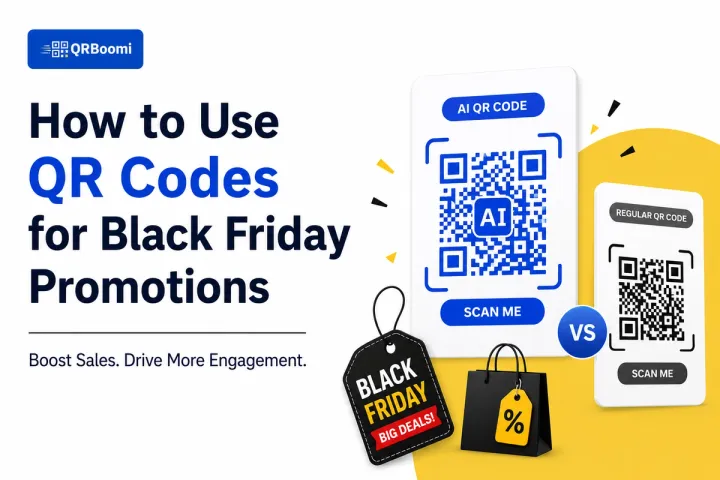
QR codes for Black Friday promotions are dynamic, scannable campaign assets placed on physical and digital touchpoints to drive shoppers from offline moments to online offers, loyalty programmes, or purchase journeys. Unlike static codes, dynamic Black Friday QR campaigns update in real time, track scan performance by location and device, and let marketers redirect traffic without reprinting a single asset.
Why Most Black Friday QR Codes Fail Before the Sale Starts
The problem is not the QR code. The problem is the campaign around it — or the absence of one.
Static codes lock in a single destination the moment they are generated. If your Black Friday landing page URL changes, if the offer updates, if you want to A/B test two promotions against each other — you cannot. The code is printed. The campaign is frozen. And when the sale ends, that code becomes a dead link that still exists on physical material in the world.
Beyond the technical limitation, most Black Friday QR campaigns share three structural failures:
No scan tracking. Brands have no idea how many people engaged, which location drove the most scans, or which device type dominated. Without that data, the next campaign starts from zero.
- Generic destinations. A QR code that sends shoppers to a homepage is a campaign dead end. Every scan needs a mobile-optimised landing page built for that exact offer, moment, and audience.
- No post-scan journey. The scan is not the conversion. What happens after the scan — the page, the CTA, the offer structure — is where campaigns win or lose.
Across QRBoomi campaigns, brands that deploy dynamic QR codes with dedicated landing pages see 2.4x higher scan-to-conversion rates than those pointing to a generic homepage or static offer page.
The Black Friday QR Campaign Framework
The QRBoomi Black Friday Campaign Lifecycle breaks the season into five execution phases. Each phase has its own objective, its own QR placement strategy, and its own conversion target.
Phase 1: Pre-Black Friday Teaser (2-3 Weeks Before)
Objective: Build scan intent and capture early opt-ins.
Deploy QR codes on packaging inserts and in-store signage that redirect to a 'coming soon' page with an SMS or email opt-in. This builds your first-party list before the sale opens. Update the destination via dynamic code the moment the sale goes live no reprint required.
Phase 2: Black Friday Launch (Day-of)
Objective: Drive immediate scan-to-cart or scan-to-offer conversion.
High-traffic placement is critical. Storefront windows, receipt footers, table displays, and checkout-area signage all earn maximum dwell time on Black Friday. Each placement should have its own dynamic code so you can track which location drives the highest scan volume and conversion.
Phase 3: Cyber Monday Extension
Objective: Redirect Black Friday scanners to Cyber Monday deals without reprinting.
This is where dynamic codes pay for themselves. Update the destination URL across all deployed codes at midnight Sunday. Every scan from every physical asset now points to your Cyber Monday offer. Zero new print spend.
Phase 4: Post-Sale Loyalty Capture
Objective: Convert one-time Black Friday buyers into repeat customers.
Redirect codes on packaging inserts and shopping bags to a loyalty programme enrolment page. Scan data tells you exactly which buyers engaged post-purchase, and when.
Phase 5: Campaign Post-Mortem
Objective: Extract insights for next year.
Pull scan analytics by date, location, device, and time of day. Which placement drove the most scans? Which destination converted best? These are the inputs for a Black Friday campaign that improves every year.
Black Friday QR Placement Strategy: Where to Deploy
Not every placement drives equal scan volume. These are the highest-performing physical and digital QR touchpoints for the Black Friday season:
| Placement | Why It Works on Black Friday |
|---|---|
| Storefront window clings | Maximum foot traffic; scans before shoppers enter — ideal for pre-qualifying offer interest. |
| Receipts and shopping bags | Post-purchase moment; perfect for loyalty capture and repeat-visit offers. |
| Packaging inserts | High-attention moment (unboxing); works for online orders fulfilled during the sale period. |
| Table cards and shelf talkers | In-aisle scan intent is high when buyers are already in decision mode. |
| Event and pop-up booth displays | Experiential touchpoints; combine QR with staff engagement for higher scan rates. |
| OOH and print ads | Bridges print spend to digital attribution — critical for proving offline ROI. |
| Email headers and footers | Digital-to-physical bridge; QR in email drives mobile engagement even from desktop viewers. |
Rule of thumb: one QR code per placement type, not one QR code for everything. Separate codes let you isolate scan performance by context.
How to Design Branded QR Codes That Get Scanned
White squares get ignored. Branded QR codes get scanned. On Black Friday, when shoppers are visually overloaded by sale signage, your code needs to stand out and signal trust at the same time.
The three design principles for high-scan Black Friday QR codes:
- Brand the code, not just the surroundings. Embed your logo at the centre. Use brand colours for the finder patterns. A generic black QR code in a sea of branded Black Friday graphics reads as an afterthought.
- Add a clear call-to-action below the code. 'Scan for 30% off', 'Scan to unlock today's deal', 'Scan to join our loyalty programme' — tell people exactly what they get. Ambiguous QR codes get skipped.
Test scannability at deployment size. A QR code that scans perfectly at 10cm on screen may fail at 3cm on a receipt. Test at the smallest intended print size before committing to print.
QRBoomi Platform Insight:
Branded QR codes (logo-embedded, custom colour) consistently outperform plain black-and-white codes across QRBoomi campaigns, with scan rates running 35-60% higher in retail environments. The design is not cosmetic. It is a conversion lever.
Tracking Scan-to-Conversion on Black Friday
Black Friday QR campaigns live and die by their analytics. Here is the data stack that actually matters:
- Scan volume by placement. Which location drove the most engagement? This tells you where to invest more signage budget next year.
- Scan volume by time of day. Black Friday scan data typically shows distinct peaks at store open, midday, and 1-2 hours before close. Time-limited offers can be sequenced to these peaks.
- Device breakdown. 93%+ of QR scans happen on mobile. If your landing page is not mobile-optimised, your campaign has a structural conversion leak.
- Scan-to-conversion rate. Scans are not conversions. Track what percentage of scans result in a form fill, purchase, loyalty enrolment, or email capture — the actual campaign objective.
- Repeat scan rate. A shopper who scans the same code twice in one day is a high-intent buyer. Flag these in your analytics for retargeting.
QRBoomi's scan-to-outcome analytics surface all of these signals in a single campaign dashboard, with no additional tracking setup required.
Real Campaign Examples by Vertical
Restaurant & Hospitality
A QR-powered Black Friday loyalty campaign at a restaurant chain: table cards with dynamic codes drive diners to a Black Friday offer page for 20% off their next visit when they join the loyalty programme. The code updates to a Christmas booking offer on December 1 — same printed card, new destination. Loyalty enrolments tracked to specific restaurant locations via scan analytics.
D2C & E-Commerce
An online brand ships all Black Friday orders with a packaging insert QR code. Scanners land on a post-purchase loyalty page with an exclusive Cyber Monday preview offer for buyers who scan within 48 hours. Scan data identifies which fulfilment batches (and by extension, which buyer segments) drove the highest post-purchase engagement.
Retail & Physical Stores
A multi-location retailer runs unique dynamic codes per store. Storefront window clings, shelf talkers, and checkout signage each carry a location-specific code. The campaign dashboard shows scan volume by store, by time, by placement — turning Black Friday into a real-time campaign intelligence exercise, not just a revenue day.
Events & Pop-Ups
A brand running a Black Friday pop-up places branded QR codes at the entry point, the product display, and the checkout. Entry scans capture awareness intent. Product display scans track interest by SKU. Checkout scans drive loyalty capture. Three codes, three data streams, one complete picture of how buyers moved through the experience.
Key Takeaways
- Black Friday QR campaigns fail when codes are static and destinations are generic. Dynamic codes with dedicated landing pages are the baseline.
- Run a five-phase campaign: teaser, launch, Cyber Monday extension, loyalty capture, post-mortem. Each phase has its own QR objective.
- Deploy separate dynamic codes per placement type. One code for everything means zero placement-level insight.
- Branded QR codes (logo-embedded, on-brand colours) drive significantly higher scan rates in retail environments than plain black-and-white codes.
- Track scan volume, time of day, device type, and scan-to-conversion rate. Scans without conversion data are just vanity metrics.
- Dynamic codes let you redirect all deployed Black Friday assets to Cyber Monday offers at midnight — with zero reprint cost.
- Every scan is a data point. At scale, Black Friday QR analytics tell you exactly where to invest next year.
The QRBoomi POV
Black Friday is not a day. It is a campaign season. Brands that treat it as one with dynamic codes that update across phases, scan analytics that attribute every touchpoint, and branded QR design that earns the scan consistently outperform brands that treat QR as a static decoration. QRBoomi is built for the campaign-season approach: create once, update continuously, measure everything. If your Black Friday QR codes are getting scans but not conversions, that is a campaign design problem, not a technology problem.
Frequently Asked Questions
Yes — if you use a dynamic QR code. Dynamic codes let you change the destination URL, offer page, or campaign content at any time without reprinting. This means your Cyber Monday redirect, post-sale loyalty page, and Christmas campaign can all run from the same printed code.
A dedicated, mobile-optimised landing page built for that specific offer and placement. Not your homepage. Not your general sale page. Each QR placement should have its own destination page, matched to the intent of the shopper scanning it.
Dynamic QR platforms like QRBoomi track every scan with timestamp, location, device type, and referral source. You can see which placement drove the most scans, when peak scan activity occurred, and what percentage of scanners converted to a defined campaign outcome.
At minimum, one per placement type — storefront, receipt, packaging, shelf talker. Separate codes give you placement-level scan data. For multi-location brands, run a unique code per location so you can compare performance across sites and allocate next year's budget by scan-to-conversion output.
Yes, when designed correctly. Logo-embedded, coloured QR codes with sufficient contrast and error correction scan reliably across modern smartphone cameras. The trade-off in scan reliability is minimal. The gain in scan rate — because the code looks intentional and on-brand — is significant.
The minimum recommended size is 2.5cm x 2.5cm for most materials. For window clings and large-format print, go larger. Always test at the smallest intended print size before finalising artwork. A code that scans at 10cm on screen may not scan at 2cm on a receipt.
With dynamic QR codes, yes. Update the destination URL at the end of Black Friday and the same printed code redirects to your Cyber Monday offer. This is one of the most practical advantages of dynamic codes over static — your physical print assets stay live across multiple campaign phases.