Most marketers asking 'should I use an AI QR code?' are asking the wrong question.
The real question is: does your QR code belong to a campaign, or is it just a link wrapped in a square?
AI-generated QR codes have captured marketing attention for one reason: they look like branded art. Embedded logos, custom shapes, patterns that reflect your visual identity. Compared to a black-and-white grid, they are undeniably more compelling.
But looking good and performing are two different things. And in QR campaign strategy, performance is the only metric that matters.
This post breaks down exactly where AI QR codes add value, where they do not, and what the comparison misses entirely when you are thinking about scan-to-outcome results.
The Problem: Design Is Getting the Credit That Campaigns Deserve
Here is the pattern we see regularly across QR campaigns: a brand invests in a beautifully designed AI-generated QR code, places it on packaging, a billboard, or an event badge, and then waits. A few weeks later, the scan numbers are underwhelming. The conclusion most teams reach: the code did not work.
The real problem was never the code. It was the campaign.
No clear destination. No mobile-optimised landing page. No A/B testing on placement. No way to update the URL when the promotion changed. No analytics beyond 'how many total scans?' And no ability to attribute those scans to a conversion event.
Meanwhile, another brand runs a standard-looking QR code on the same channel, but it is dynamic, fully tracked, and points to a campaign-specific landing page. Their scan-to-lead rate is 3 to 4 times higher.
The difference is not AI vs regular. The difference is campaign infrastructure.
What Is an AI QR Code?
An AI QR code is a QR code whose visual design is generated or enhanced using artificial intelligence tools. These tools use diffusion models or neural style transfer to blend the functional QR matrix pattern with custom imagery, brand colours, logos, or patterns, while maintaining scannability.
The output can range from subtle branded customisation to full artistic integration where the QR code almost disappears into an image. The encoding itself follows the same ISO/IEC 18004 standard as any other QR code. AI is applied to the aesthetics, not the data structure.
Popular tools for AI QR generation include QR Diffusion models, QR Code AI (various platforms), and custom fine-tuned Stable Diffusion pipelines.
What Is a Regular QR Code?
A regular QR code is a machine-readable matrix barcode that encodes a URL, text, or other data using a standardised black-and-white pattern. It is scannable by any smartphone camera without additional software.
'Regular' does not mean featureless. A regular QR code can be static (fixed destination) or dynamic (editable destination). It can carry brand colours, a central logo, and custom finder patterns through traditional QR design tools, without AI generation.
The distinction that matters for marketers is not AI vs non-AI. It is static vs dynamic, and tracked vs untracked.
The Comparison That Marketers Actually Need
Most AI vs regular QR code comparisons focus on visual quality. Here is the comparison that drives campaign decisions:
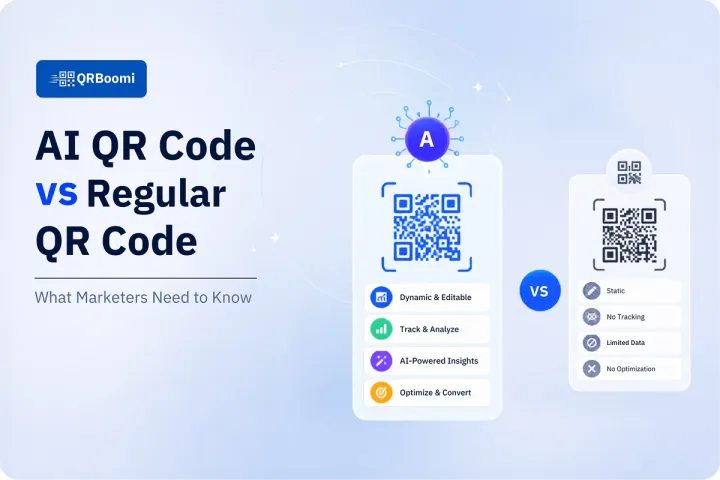
| Dimension | AI-Generated QR Code | Regular QR Code (Dynamic) | What Matters for Campaigns |
|---|---|---|---|
| Visual Design | Generative, highly customised, brand-immersive | Custom colours, logo, finder patterns | Branded design increases scan intent in high-traffic environments |
| Scannability | Variable — depends on generation quality; error correction is critical | Consistent — predictable across all readers | Reliability matters more than aesthetics for repeat-use campaigns |
| Destination Editability | Depends on the platform used, not the design tool | Dynamic codes update without reprinting | Update without reprinting is a campaign essential, not a luxury |
| Analytics | Not a feature of the design tool | Full scan-to-outcome tracking available | Scan volume without attribution is a vanity metric |
| Campaign Lifecycle | One-off generation; no campaign management | Full lifecycle: create, deploy, track, update | Campaign management is where ROI is built or lost |
| Cost to Update | Reprint required if static destination | No reprint needed for dynamic codes | Dynamic codes reduce campaign cost at scale significantly |
Where AI QR Code Design Adds Real Campaign Value
When AI-generated QR design is used correctly, it serves a specific campaign function: it removes the hesitation to scan.
Across QRBoomi campaigns in retail, events, and out-of-home advertising, scan rates are consistently higher when QR codes carry visible brand identity. A code that looks like it belongs to the campaign, rather than a placeholder bolted onto creative, earns more first-contact trust.
Here is where the aesthetic investment pays off:
1. High-Traffic Physical Environments
Event signage, retail endcaps, trade show booths. These are environments where the code competes for attention with everything else in the space. A visually compelling, on-brand code earns the glance. An anonymous black-and-white square does not.
2. Premium Packaging and Unboxing Experiences
For D2C brands, the unboxing moment is the highest-attention touchpoint in the customer journey. An AI-designed QR code that integrates into the packaging art signals intent. It says: this code was designed for you, not added at the last step. That signal converts.
3. Brand-Led Social Campaigns
When the QR code appears in content that will be shared, screenshotted, or saved, design quality matters beyond the first scan. Campaigns where the code itself becomes part of the visual identity see secondary scan activity from shared images. AI-generated designs are more likely to survive compression and reposting while remaining scannable.
Where Design Alone Does Not Drive Campaign Metrics
Here is the part most AI QR code content does not tell you: a beautifully designed code sent to a slow-loading, non-mobile-optimised page will underperform a plain-looking code sent to a fast, campaign-specific landing page. Every time.
Design influences the decision to scan. Everything after the scan is campaign execution.
The post-scan experience includes:
• Landing page load speed (under 2 seconds on mobile is the threshold)
• Page relevance to the physical context where the code appeared
• A clear, single call to action above the fold
• Personalisation based on scan location, device, or time
• Follow-up capability through captured first-party data
None of these are features of a design tool. All of them are features of a campaign platform.
The QRBoomi Campaign Scan Framework
Across campaigns run on QRBoomi, scan-to-conversion performance follows a consistent pattern. We call this the QRBoomi Campaign Scan Framework. It has four stages:
| Stage | What Happens | What Drives Performance |
|---|---|---|
| 1. Scan Intent | The person notices and decides to scan | Brand-quality design, clear context, visible value signal |
| 2. Landing Moment | First view of the destination page | Mobile optimisation, load speed, message match to physical context |
| 3. Conversion Event | The action you wanted them to take | Single CTA, frictionless interaction, relevant offer |
| 4. Attribution Loop | Tying the scan to a business outcome | Dynamic tracking, UTM parameters, scan-to-CRM data |
Stage 1 is where AI-generated design has its highest impact. Stages 2, 3, and 4 require campaign infrastructure. A QR code that excels at Stage 1 but has no support for Stages 2 through 4 produces scan data that means nothing.
Every scan is a data point. But only when you have the infrastructure to collect, interpret, and act on it.
Static vs Dynamic: The Comparison That Matters More Than AI vs Regular
The debate between AI-generated and regular QR codes is ultimately a design debate. The debate between static and dynamic QR codes is a campaign strategy debate. And for marketers, campaign strategy wins.
Static QR codes lock in a destination at creation. Print 10,000 boxes, run one campaign, point the code to your homepage. Three months later, the promotion is over, but the code still exists on every unit in the market, sending people to a dead page.
Dynamic QR codes are campaign-native. The URL behind the code is editable at any time, without reprinting. Change the destination, update the landing page, run seasonal variations, A/B test offers. The code on the physical material stays the same. The campaign underneath it evolves.
The performance gap between static and dynamic QR campaigns is significant. Dynamic codes, used with campaign intent and tracked properly, consistently outperform static codes across:
• Scan-to-conversion rate (destination relevance is maintained throughout the campaign lifecycle)
• Campaign cost efficiency (no reprint cost when strategy changes)
• Attribution accuracy (full scan event data available by location, device, and time)
• Post-scan engagement (landing pages can be personalised and updated in real time)
QRBoomi's view: The AI vs regular QR code question is a design question. The static vs dynamic question is a campaign question. Marketers who focus only on how their code looks will always leave performance on the table. What moves metrics is the combination: branded, visually compelling design on the front end, and a dynamic, fully tracked campaign engine underneath. That is the standard QRBoomi was built around.
Start Running QR Campaigns That Convert
If your QR codes are getting scans but not conversions, that is a campaign design problem, not a technology problem. QRBoomi gives you dynamic codes that update after deployment, full scan-to-outcome analytics, branded design tools, and a landing page builder, all in one campaign platform.
Key Takeaways
• AI QR codes apply generative design to the visual layer of the code. They do not affect scannability standards, editability, or analytics capability.
• Regular QR codes, when dynamic and properly tracked, consistently outperform AI-designed static codes in scan-to-conversion campaigns.
• Design quality at Stage 1 (scan intent) does improve click-through in high-attention environments. Combined with a strong post-scan experience, the impact compounds.
• The comparison that drives real campaign decisions is static vs dynamic, not AI vs regular.
• Every scan is a data point. But only a dynamic, tracked campaign lets you act on that data.
• The QRBoomi Campaign Scan Framework (Scan Intent > Landing Moment > Conversion Event > Attribution Loop) is the lens that makes this comparison actionable.
Frequently Asked Questions
Not inherently. Scannability depends on error correction level, contrast ratio, and quiet zone around the code, not the design method. Some AI-generated codes push visual complexity to the point of reducing reliability. Always test scan rates across devices and lighting conditions before deploying at scale.
No. AI QR code generators are design tools, not campaign platforms. Tracking capability is a function of whether the code is dynamic and connected to an analytics platform. You can have a beautifully AI-designed QR code with zero tracking, or a standard-looking code with full scan-to-outcome attribution. Campaign infrastructure determines what you can measure.
Only if the underlying code is dynamic, regardless of how it looks. The visual design of a QR code has no relationship to whether the destination is editable. To update without reprinting, you need a dynamic QR platform. Design tools that generate AI codes typically produce static codes unless explicitly integrated with a dynamic QR service.
They are different categories entirely. AI QR codes describe the visual generation method. Dynamic QR codes describe the campaign functionality. A code can be both, either, or neither. For marketers, dynamic functionality delivers the campaign ROI. Visual design influences scan intent. The best campaigns combine both.
In high-attention physical environments, yes. Across QRBoomi campaigns, branded QR codes with embedded logos and on-brand colour schemes consistently outperform white-square codes in environments with visual competition, such as events, retail, and OOH. The lift at the scan-intent stage ranges from noticeable to significant depending on placement.
Dynamic QR codes with branded design give packaging campaigns the most campaign flexibility. The visual element increases scan intent at the point of unboxing. The dynamic functionality means the destination can be updated across the product lifecycle without reprinting. Tracking capability closes the attribution loop from physical product to digital conversion.
QRBoomi's branded QR design tools let you create campaign-grade QR codes with custom colours, embedded logos, and on-brand styling, all within a dynamic, fully tracked campaign platform. If you have an AI-generated image you want to incorporate, the QRBoomi team can advise on integration options. The priority is always scannability and campaign performance.